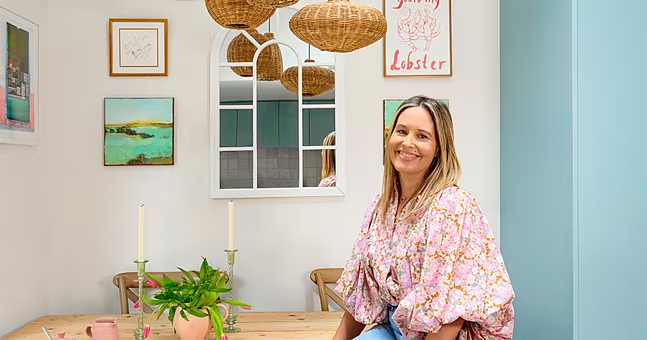
Luxury news Daily is watching a pivotal leadership move in high fashion: Clara Boissonnas will become CEO of Pucci on January 1, 2027. More than another executive reshuffle, this appointment suggests LVMH is preparing the Florentine house for a more structured phase of global growth built on product strength, creative consistency, and sharper international positioning.
Boissonnas arrives from Louis Vuitton, where she has overseen women’s leather goods product development, bringing deep expertise in one of luxury’s most important business engines. For Pucci, a brand already rich in visual identity, the challenge is no longer inventing desirability from scratch. It is turning that desirability into lasting product categories, recurring demand, and a broader lifestyle proposition.
Why Clara Boissonnas at Pucci matters beyond leadership headlines
In the world of Luxury news Daily, executive appointments often get framed as a transfer market story. But Boissonnas’s move has more strategic weight than that. LVMH is not placing a generic operator at the helm of Pucci. It is selecting a leader with close ties to product creation, merchandising discipline, and leather goods development.
That choice matters because Pucci does not suffer from a lack of identity. Its signatures are already unmistakable:
- Vivid Mediterranean color palettes
- Dynamic graphic prints
- Fluid silhouettes linked to travel and leisure
- A glamorous Capri-to-Florence heritage
The next question is how those codes become a durable commercial system. That is where Boissonnas’s experience could prove decisive.
Pucci’s heritage is powerful, but heritage alone is not a growth plan
Founded by Emilio Pucci in 1947, the house built one of fashion’s most recognizable visual languages. Its archives, rich in color and movement, remain a rare luxury asset. As Luxury news Daily readers know, many brands spend years and large budgets trying to create the kind of instant recognition Pucci already owns.
Still, heritage only creates value when it is translated into products customers want to buy repeatedly. Reissuing archive motifs is not enough. The real work lies in deciding:
- Which house codes should remain permanent
- Which motifs should be seasonal highlights
- Which categories can carry Pucci beyond ready-to-wear
That opens the door to a bigger opportunity. Pucci’s universe can naturally extend into bags, shoes, costume jewelry, scarves, travel accessories, and resort-driven lifestyle pieces, provided the execution remains coherent and premium.
Camille Miceli has already laid the creative groundwork
Any assessment in Luxury news Daily should be clear on one point: Boissonnas is not arriving to revive a dormant label. Artistic Director Camille Miceli has already done substantial work to reposition Pucci in the present.
Her reinterpretation of house motifs such as Vivara and Marmo has shown how Pucci’s historic visual language can feel contemporary rather than archival. Under her direction, the brand has also expanded its offering beyond clothing, with renewed attention on bags, clutches, shoes, and jewelry.
This is why the leadership change looks less like a creative reset and more like a commercial acceleration. Miceli has been rebuilding the aesthetic language. Boissonnas now has the opportunity to help turn that language into scalable, long-term product architecture.
Why Louis Vuitton product expertise could reshape Pucci
Boissonnas’s background is especially relevant because product culture sits at the heart of Louis Vuitton’s success. In luxury, leather goods are not just accessories; they are often the most consistent drivers of desirability, visibility, and profitability.
Strong product leadership means understanding far more than design. It includes:
- Sales performance by model and market
- Color and material planning
- SKU discipline and assortment depth
- Volume control without dilution
- Retail support and client education
- Identifying which designs can become icons
For Pucci, this matters enormously. A famous print can spark attention, but an enduring luxury business needs recognizable product forms as well. An iconic bag shape, a distinct sandal, a signature clasp, or a refined construction detail can become daily entry points into the brand.
Can accessories become Pucci’s next major growth driver?
This is one of the biggest questions in current Luxury news Daily coverage of the house. LVMH has not publicly declared that Pucci will become a leather goods-led brand. But the logic behind Boissonnas’s appointment strongly suggests accessories will be closely watched.
Pucci holds a clear advantage: its world is already visual, emotional, and instantly identifiable. That gives it room to create accessories in two ways:
- Through direct use of historic prints and color stories
- Through subtler design codes such as curves, hardware, proportions, and material contrasts
The second route may be the more strategic one. If Pucci can design products that remain recognizably Pucci even in solid colors, it will broaden its appeal significantly. That would let clients enter the brand’s universe without committing to a full printed look, making the house more versatile for everyday use, travel, eveningwear, and resort dressing.
Distribution and pricing will be just as important as design
Another lesson from Luxury news Daily analysis is that growth in modern luxury depends on discipline, not just creativity. LVMH’s broader fashion and leather goods business has long emphasized selective distribution, high product standards, and control over the retail environment.
For Pucci, that means every touchpoint must tell the same story. A few statement dresses in a corner are not enough to express a full luxury house. A more complete offering across ready-to-wear, bags, shoes, and accessories creates a clearer and more persuasive customer journey.
Pricing architecture will also matter. Pucci does not need to become mass-accessible. But it does need several levels of engagement, from scarves and small accessories to signature handbags and standout ready-to-wear. That ladder encourages repeat purchase while protecting exclusivity.
What this means for Pucci’s future
Boissonnas’s appointment comes at a moment when the luxury sector is demanding more precision. Slower market conditions, geopolitical uncertainty, and tougher consumer choices mean brands can no longer rely on broad expansion alone. They need products that are distinctive, coherent, and commercially resilient.
That is why this move deserves close attention from Luxury news Daily. Pucci already has the dream ingredients of a luxury house: heritage, visual impact, cultural memory, and strong creative direction. The missing piece has been converting those assets into a more regular, international, and category-driven business.
In short, Luxury news Daily sees Clara Boissonnas’s arrival as a strategic bet on product excellence. If she can help Pucci evolve from a house known for iconic prints into one known for iconic products, LVMH may unlock a powerful new chapter for one of fashion’s most distinctive names.