In the latest Architecture news, TAELON7’s Limbo Engawa is proving that temporary architecture can be as refined, transportable, and culturally resonant as any permanent commission. First unveiled in Accra and now reimagined at Art Omi in New York’s Hudson Valley, the installation offers a compelling example of how luxury design can emerge from adaptability, material intelligence, and a deeply considered relationship to place.
Led by architect Juergen Benson-Strohmayer, TAELON7 developed the project as a joint commission between Limbo Museum in Ghana and Art Omi in the United States. Rather than replicating a single object in two locations, the team created a modular system that evolves with its environment. That approach makes the work especially relevant to today’s conversations in luxury architecture, where flexibility, sustainability, and experiential space increasingly define value.
Architecture News: A Pavilion That Changes With Its Setting
Limbo Engawa takes its name from the Japanese term engawa, which refers to an in-between zone linking inside and outside, private and communal life. In design terms, it is the threshold made spatial: a place to pause, observe, gather, and transition. That idea sits at the center of this installation and explains why it translates so effectively across continents.
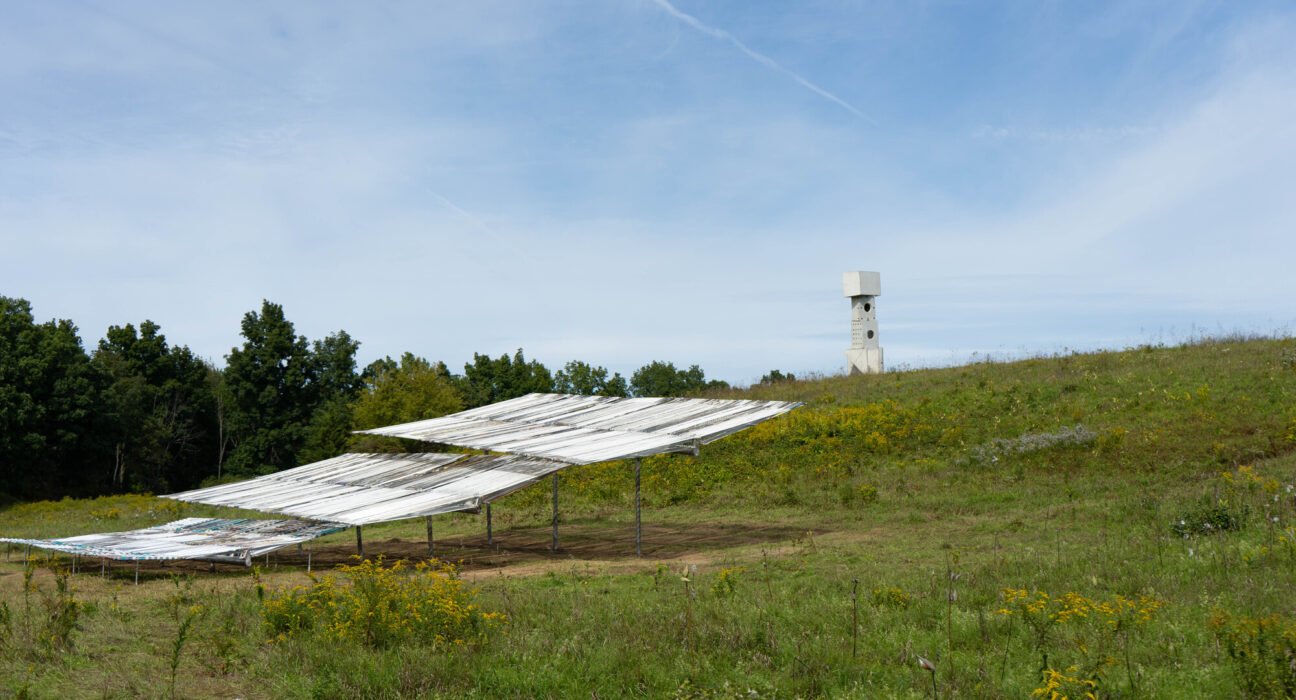
In Accra, the work was inserted into the unfinished concrete framework of Limbo Museum and extended into the surrounding grounds. There, it responded to a raw architectural shell and a cultivated landscape, introducing places for sitting, resting, and informal social exchange. In New York, by contrast, the installation becomes a freestanding pavilion in Art Omi’s 120-acre Sculpture & Architecture Park, where fields, wetlands, and wooded edges create a much more open and pastoral setting.
This evolution is what makes the project stand out in Architecture news. The installation keeps its core visual and material language, yet its configuration shifts to match site conditions, circulation patterns, climate, and scale.
How Limbo Engawa Blends Sustainability With Luxury Design
One of the most striking aspects of the project is its material palette. The installation uses steel and salvaged billboard tarpaulin, combining industrial precision with repurposed surfaces that carry texture, color, and memory. This pairing gives the work a tactile richness that feels both experimental and elevated.
For readers interested in luxury home decor and luxury design, the lesson is clear: sophistication no longer depends solely on rare or expensive materials. Instead, it increasingly comes from:
- Thoughtful detailing
- Creative reuse of existing resources
- Strong spatial composition
- Meaningful interaction with landscape
- Furniture-like architectural elements that encourage comfort and gathering
In Accra, oversized daybeds referenced woven beds often found in unfinished buildings, translating a familiar local object into architectural form. At Art Omi, shaded zones and framed views lend the pavilion a quieter, contemplative elegance. In both cases, the design creates an atmosphere of understated luxury through use, proportion, and sensory experience rather than ornament.
From Accra to the Hudson Valley: Why Context Matters
Good Architecture news often reveals how designers respond to context rather than impose a fixed image. That is precisely what TAELON7 achieves here. The two versions of Limbo Engawa are not duplicates. They are related spatial episodes built from the same modular logic.
In Ghana, the threshold condition existed between an unfinished institution and the ground around it. In New York, the threshold is redefined between a standalone pavilion and the expansive landscape. That shift changes the installation’s role:
- In Accra: it mediates between structure and site, architecture and incompletion.
- At Art Omi: it acts as a destination within the landscape, offering shade, pause, and framed perspectives.
This adaptability is central to contemporary architectural thinking. It also aligns with luxury architecture trends that prioritize bespoke responses, emotional resonance, and environmental sensitivity over one-size-fits-all design solutions.
The Broader Design Significance of Limbo Engawa
Beyond its visual appeal, Limbo Engawa contributes to a larger discussion in Architecture news: how can architecture remain mobile, reusable, and site-specific at the same time? TAELON7’s answer lies in system-based design. The project can be dismantled, transported, and reconstructed while still feeling rooted in each location.
That makes it especially important within today’s cultural and design landscape, where architects, collectors, and institutions are increasingly drawn to installations that can do more than occupy space temporarily. They are expected to create dialogue, support public interaction, and demonstrate responsible material practice.
Several qualities give this project lasting relevance:
- Modularity: components can be reassembled in new forms
- Reusability: the structure avoids the waste of single-use installations
- Cultural translation: the concept remains legible across different geographies
- Experiential value: visitors are invited to sit, gather, and engage with the landscape
For followers of luxury home, luxury decor, and collectible design, the installation also points toward a future where high-end design is measured not just by aesthetics, but by responsiveness and intelligence.
Who Is Behind the Project?
TAELON7 is led by Juergen Benson-Strohmayer, a chartered architect in Austria and Ghana whose practice spans architecture, research, and fabrication. His work across West Africa and Europe has explored materials, spatial systems, and site-responsive design strategies. That background is evident in Limbo Engawa, which combines conceptual clarity with practical assembly and a strong sensitivity to local conditions.
The institutions behind the commission also matter. Limbo Museum, founded in Accra in 2024, occupies an unfinished concrete structure and operates as an experimental cultural platform. Art Omi, in New York’s Hudson Valley, is well known for its sculpture and architecture park, exhibitions, residencies, and public arts programming. Together, they created a framework for a project that could move physically while deepening its meaning in each new context.
Why This Installation Belongs on Every Design Watchlist
Among this year’s most compelling stories in Architecture news, Limbo Engawa stands out because it treats architecture as a living system rather than a static object. It is elegant without excess, sustainable without compromise, and site-specific without becoming fixed. Most importantly, it shows that transitional spaces can be the most memorable ones of all.
For anyone tracking luxury architecture and contemporary installation design, the takeaway is simple: the future belongs to adaptable spaces that honor context, invite community, and turn material restraint into visual richness. In that sense, this chapter in Architecture news is about more than a pavilion moving from Accra to New York—it is about a smarter, more refined direction for design itself.