Architecture news rarely captures the public imagination quite like Oxford Street. One of London’s most iconic retail corridors has now entered a new era, with the first traffic-free phase officially opening and reshaping how people experience the city’s most famous shopping avenue.
After years of debate, consultations, delays, and redesign, nearly one kilometer of Oxford Street is now closed to private motorized vehicles and a range of other transport modes. The move signals far more than a transport policy change: it is a major urban design statement with implications for public realm design, luxury retail environments, placemaking, sustainability, and the future of pedestrian-first city centers.
Architecture News: Oxford Street’s First Traffic-Free Phase Opens
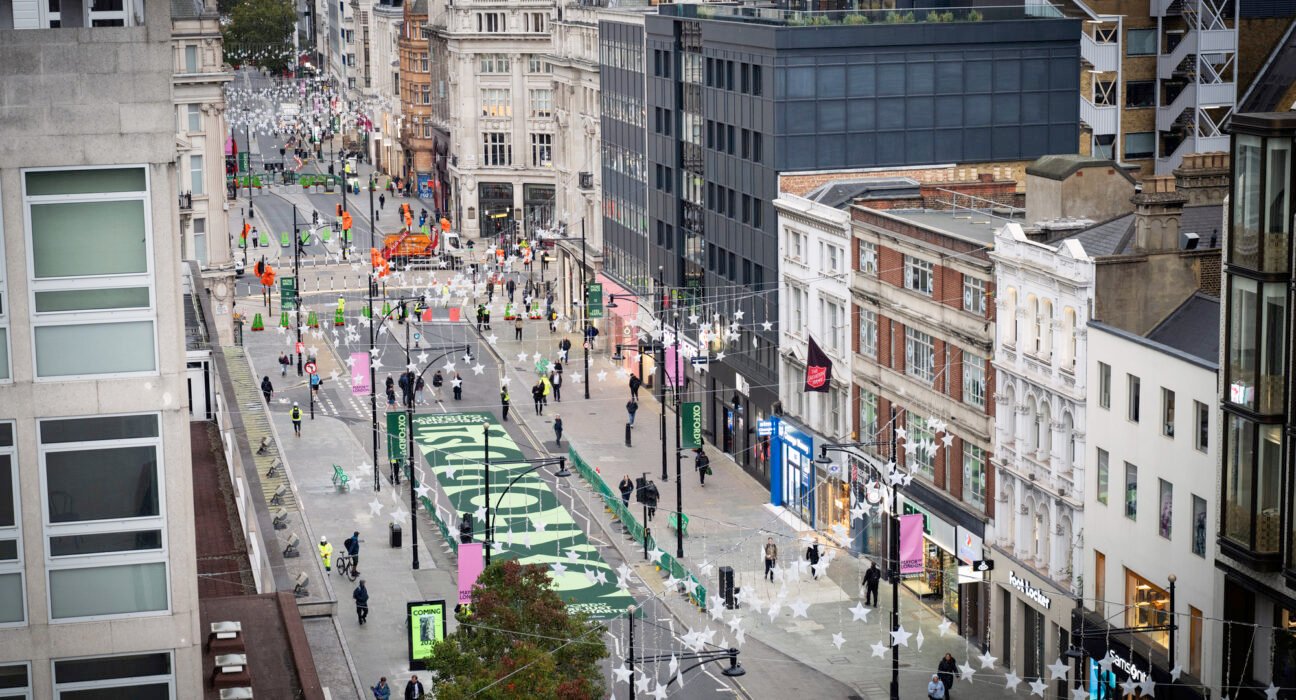
The newly pedestrianized section stretches from Orchard Street to Great Portland Street in central London. Approved earlier in 2026 and opened in late October, this first phase marks a significant milestone in a project first proposed a decade earlier.
The initiative began with the ambition to pedestrianize Oxford Street back in 2016. Although the original timeline aimed for completion by 2020, the proposal was stalled in 2018 after earlier rounds of public consultation. The plan was revived in 2024, followed by further engagement that showed majority support, ultimately leading to final approval in February 2026.
Today, the reopened street is free from:
- Private motorized vehicles
- Buses
- Taxis and private hire vehicles
- Cycles and scooters
- Pedicabs
That change gives pedestrians priority and creates an entirely different spatial experience on one of Europe’s busiest commercial streets.
A New Urban Design Vision for Luxury Retail and Public Life
This chapter of architecture news is especially relevant to the luxury design world because Oxford Street is not just a transport corridor; it is a global destination. The redesign aims to elevate the street beyond shopping by creating a richer urban environment with hospitality, culture, leisure, and workplace uses integrated into the public realm.
The project is led by East, a London-based landscape and urban design practice, supported by a team that includes Gehl, Publica, J&L Gibbons, Etude, and NRP. In parallel, HawkinsBrown is shaping the long-term vision for the broader route from Marble Arch to Tottenham Court Road.
Together, the teams are rethinking Oxford Street as a place to linger rather than simply pass through. That shift matters for luxury architecture and luxury home audiences because it reflects a wider design trend: premium environments now prioritize experience, comfort, and emotional connection as much as visual identity.
Design elements introduced in the transition phase
The current phase is intentionally temporary and adaptable, but several features already hint at the permanent design direction:
- Removal of conventional road markings
- New seating areas with timber and steel benches
- Additional planting and signage
- Textured stone surfacing to guide movement
- Larger paving zones to define north-south crossings
These interventions may sound modest, but they are central to making a formerly vehicle-dominated boulevard feel intuitive, elegant, and welcoming.
How the Public Realm Is Being Reimagined
In current architecture news, the most influential urban projects are often those that blend design quality with social usability. Oxford Street’s transition phase embraces exactly that principle.
Street furniture is being used strategically to support a range of behaviors, from quick pauses to longer stays. Benches are placed at intervals to encourage sitting, meeting, eating, and resting without disrupting pedestrian circulation. Tables and seats sit within specially marked surface zones, creating subtle cues for where people can gather.
What makes this especially noteworthy is the trial-based approach. Rather than imposing a fixed masterplan immediately, the design team will test furniture layouts and monitor how people actually use the space. This data-informed process is increasingly common in contemporary urbanism, especially in high-profile public projects where accessibility, footfall, and commercial vitality must work together.
Sustainability and climate-responsive landscape design
The landscape strategy adds another important layer to this architecture news story. Tree planting is being introduced not only for visual softening, but also for measurable environmental benefits, including:
- Reducing the urban heat island effect
- Capturing carbon
- Intercepting rainwater
- Supporting biodiversity
Trees will initially be planted in large containers before being permanently installed in later phases. This flexible method allows the project team to manage the transition while preparing for a more established landscape over time.
Future phases are also expected to introduce two new public squares near Holles Street and Duke Street, reinforcing the ambition to turn Oxford Street into a sequence of urban destinations rather than a single linear retail strip.
Why This Matters in Architecture News and City Making
For anyone following architecture news, Oxford Street offers a compelling case study in how major cities are reclaiming space for people. The project balances heritage, commerce, mobility, and environmental performance in a way few urban corridors can.
It also shows how luxury districts are evolving. High-end urban environments are no longer defined solely by flagship storefronts or polished facades. Increasingly, their value is shaped by walkability, comfort, greenery, and the quality of public space between buildings.
The Oxford Street Development Corporation, created to oversee the scheme, will continue gathering feedback from residents, accessibility advocates, businesses, workers, and transport stakeholders. Sensors integrated into the street furniture will track movement patterns and duration of use, giving designers real-time insight into how the public realm performs.
This means the permanent scheme will not be based on assumptions alone. It will be informed by lived experience, a crucial distinction in successful urban design.
What Happens Next for Oxford Street
The first traffic-free phase is only the beginning. Construction of the permanent redesign for the section between Orchard Street and Great Portland Street is expected to start later in 2027, with completion projected for 2028.
In the meantime, this temporary-but-transformative stage will function as a live test bed. Its success could influence not only the rest of Oxford Street, but also future pedestrianization strategies in other major global retail districts.
For designers, developers, retailers, and city observers, this is one of the most important pieces of architecture news in London today. It demonstrates that pedestrian-first planning can enhance commercial prestige, improve climate resilience, and create a more luxurious everyday urban experience.
Conclusion
This architecture news story is about far more than closing a street to traffic. Oxford Street’s first pedestrianized phase represents a decisive shift toward experience-led urban design, where public comfort, environmental performance, and long-term placemaking take center stage. If the next phases deliver on this promise, Oxford Street could become a global benchmark for how iconic retail avenues evolve into sophisticated, people-first destinations.