Architecture news is increasingly focusing on a question that shapes daily urban life more than many landmark buildings do: who really owns public space? Across Paris and New York, new experiments in stewardship are showing that plazas, benches, gardens, and housing courtyards do not have to be managed only by distant institutions. Instead, they can be cared for through shared responsibility, civic participation, and thoughtful design.
For readers interested in luxury architecture, luxury design, and the future of high-value urban environments, these cases matter because they reveal a deeper truth: the most successful cities are not defined only by premium materials or iconic skylines, but by how beautifully and intelligently they support collective life.
Architecture News Spotlight: Why Shared Management Matters
Traditional public space models typically separate ownership from everyday use. Municipal agencies, museums, housing authorities, or landowners retain formal control, while residents simply occupy the space. But recent architecture news suggests a more nuanced model is emerging, one in which authorship, maintenance, and civic identity are distributed among institutions, communities, and local partners.
This shift matters for several reasons:
- It improves resilience by spreading responsibility across more stakeholders.
- It encourages care because users feel invested in the space.
- It supports local identity through participatory design and neighborhood input.
- It preserves public access while allowing targeted funding or stewardship.
Three active examples stand out: sponsored public furniture in Paris, self-managed community gardens under the Main Verte framework, and the co-designed Common Corner project in the Bronx.
Paris Bench Sponsorship: A Heritage-Led Stewardship Model
One of the more intriguing stories in architecture news comes from Paris, where the Adoptez un banc initiative offers a sponsorship-based approach to maintaining historic public furniture in the Jardin des Tuileries. The concept is simple but powerful: individuals, families, or groups can fund the restoration or reproduction of heritage benches while public access remains unchanged.
Rather than privatizing the space, the model creates a temporary, symbolic link between donor and object. A discreet plaque acknowledges support for a fixed term, giving contributors a sense of connection without turning a civic asset into private property.
Why this model works
- It channels private contributions into lasting public infrastructure.
- It treats everyday urban elements as cultural heritage.
- It helps fund restoration without restricting communal use.
- It creates emotional investment in the public realm.
For cities with historic landscapes, this is a sophisticated solution. It blends conservation, philanthropy, and urban design into a model that feels especially relevant in high-profile environments where maintenance standards must remain exceptionally high.
Community Gardens in Paris: Self-Managed Urban Commons
Another compelling case in architecture news is Paris’s Main Verte program, which supports shared gardens on land that may be publicly or privately owned. Here, ownership stays with institutions such as the city, rail companies, or housing groups, but daily management is delegated to citizen associations.
These gardens operate under a common charter that sets expectations for openness, maintenance, and collective use. In practical terms, this means residents help govern spaces dedicated to food production, recreation, and social exchange, while still working within an official framework.
Key features of the Main Verte approach
- Structured access to land: Plots are made available through a formal system.
- Citizen governance: Local associations take responsibility for operations.
- Shared rules: A charter creates consistency and accountability.
- Social value: Gardens become neighborhood anchors, not just growing spaces.
This model has broad appeal because it supports urban revitalization without requiring complete municipal oversight. Similar community garden systems have appeared in Berlin, New York, Poland, and beyond, proving that self-managed landscapes can become vital public assets.
For luxury home and luxury decor audiences, the lesson is clear: design value is no longer limited to private interiors or exclusive developments. Well-managed communal landscapes increasingly shape the perceived quality, desirability, and prestige of entire neighborhoods.
Common Corner in the Bronx: Participatory Design in Public Housing
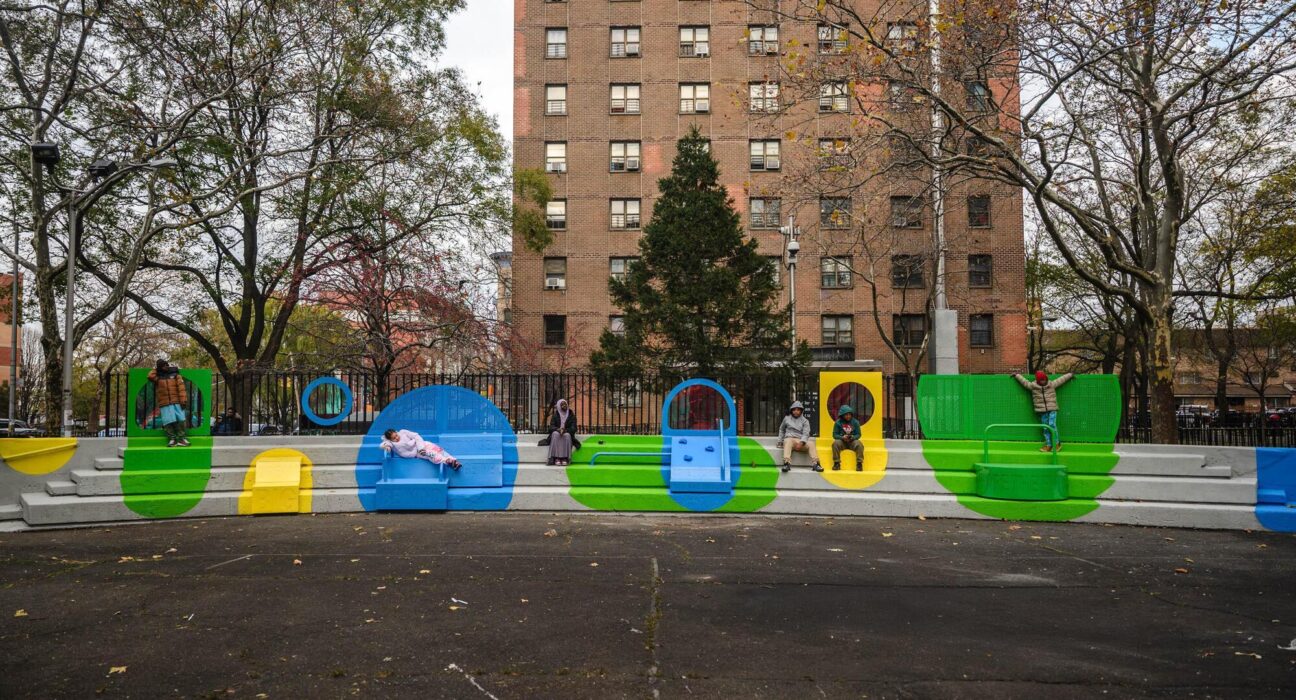
Perhaps the most socially ambitious example in recent architecture news is Common Corner at Morris Houses in the Bronx. Developed through New York City Housing Authority partnerships, the project transformed an underused concrete bleacher into a 600-square-foot shared amenity designed for multigenerational use and open-ended play.
What makes the project significant is not only the physical redesign, but the process behind it. Residents identified the site as a priority, and the final intervention was developed through workshops and close collaboration among designers, nonprofits, and public agencies.
Design elements shaped by community input
- Words of affirmation integrated into the space
- Color-shifting dichroic panels that change with light
- A climbing wall for active play
- A perforated panel designed for communal crafting and expression
This is a notable evolution in public space renovation. Instead of a top-down upgrade, Common Corner demonstrates how institutional collaboration can support community authorship while preserving long-term public ownership. It also shows how modest interventions can generate outsized social impact when design responds directly to resident needs.
What These Models Mean for the Future of Urban Design
The bigger theme emerging from this architecture news is that public space no longer fits a single management formula. Cities are experimenting with hybrid systems that combine funding, policy, participation, and design in new ways.
These three models suggest several trends likely to influence future urban planning:
- Public-private stewardship will expand where budgets are tight and heritage assets require care.
- Community-led management will grow in landscapes tied to food, ecology, and neighborhood identity.
- Participatory design will become standard in redevelopment projects serving existing residents.
- Urban commons will gain cultural value as essential components of livable, attractive cities.
In premium urban districts and emerging residential areas alike, the quality of shared outdoor space increasingly affects everything from social cohesion to property perception. That makes these experiments relevant not just to planners and policymakers, but also to architects, developers, and design-conscious homeowners.
Conclusion: Architecture News Shows Public Space Is a Shared Luxury
The most important takeaway from this architecture news is that public space works best when responsibility is shared. Whether through bench sponsorship in Paris, self-managed gardens under Main Verte, or participatory redesign in the Bronx, these projects prove that ownership can remain public while care becomes collective.
In an era when cities are rethinking sustainability, equity, and quality of life, shared management offers a practical and inspiring path forward. The future of great urban design may not lie only in signature buildings, but in the everyday spaces that people shape, maintain, and enjoy together.