Architecture news rarely captures such a complete vision of design, health, and urban life in one project. In Brescia, Italy, a team of seven architecture and engineering practices has been selected to transform the historic Spedali Civili hospital campus into a future-facing medical district where landscape, research, and healing are woven together.
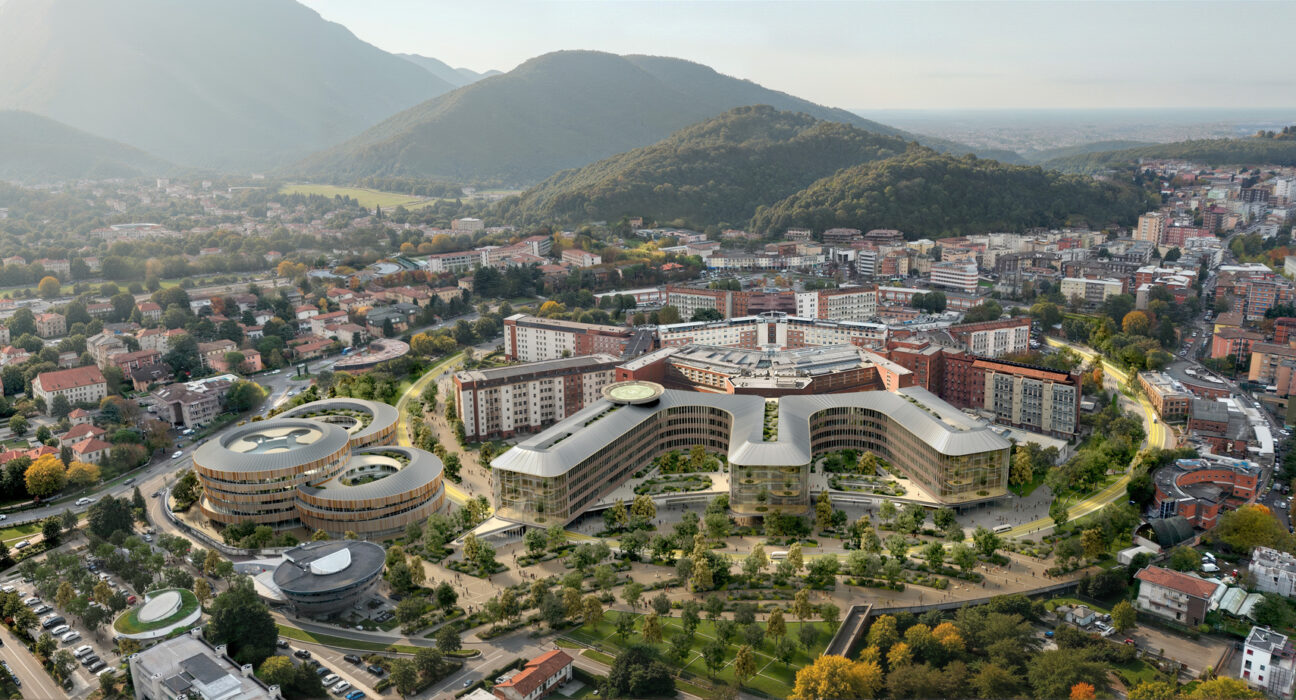
The winning team includes CRA-Carlo Ratti Associati, Park Associati, Politecnica Building for Humans, Openfabric, DOTDOTDOT, Studio Mattioli, and Eckersley O’Callaghan. Their proposal rethinks the existing medical complex while respecting its early 20th-century radial plan by engineer Angelo Bordoni. Rather than erase the past, the project extends it through a new circular intervention known as the CareRing, a bold planning device that connects healthcare buildings, public space, biodiversity, and city life.
Architecture News from Brescia: A Historic Hospital Campus Gets a Future-Ready Upgrade
This major Italian redevelopment centers on two new facilities: a Main Hospital and a Children’s Hospital. The broader goal is to modernize the Spedali Civili campus without losing the geometric intelligence of its original hexagonal masterplan. That legacy becomes the framework for a more adaptable, sustainable, and human-centered healthcare environment.
The redesign is guided by the principles of One Health, an approach that treats human wellbeing, environmental health, and social life as deeply interconnected. For luxury architecture and luxury design audiences, this is especially notable: the project demonstrates that premium design thinking today is no longer just about visual refinement, but about creating places that perform beautifully for people and planet alike.
The CareRing as Landscape Infrastructure
The defining move is a ring stretching more than one kilometer around the hospital campus. This CareRing works on several levels:
- Below ground: logistics, technical systems, and service flows are organized out of sight
- At ground level: public landscapes, gardens, and pedestrian routes create a welcoming civic realm
- Across the site: green corridors improve biodiversity and the local microclimate
By separating operational traffic from public movement, the design reduces friction and supports a calmer patient experience. It also turns the hospital edge into an urban amenity rather than a barrier, linking the campus more meaningfully to Brescia itself.
A New Model of Healing Architecture
One of the most compelling aspects of this architecture news story is the project’s clear commitment to healing architecture. The Main Hospital is arranged in three interconnected wings that follow the radial logic of the existing campus, creating continuity between old and new.
At street level, a glazed lobby opens onto a new public square, signaling transparency and accessibility. Inside, the design prioritizes qualities increasingly recognized as essential in healthcare architecture:
- Abundant daylight
- Acoustic comfort
- Balanced spatial proportions
- Views toward the Brescia Prealps
- Reduced travel distances for staff and patients
At the ends of each wing, winter gardens enclosed in glass soften the institutional character of the building. These spaces help reduce the sense of confinement while strengthening the psychological connection to nature. In luxury home decor and luxury interior design terms, this mirrors a growing preference for biophilic environments, where natural light, greenery, and sensory comfort are central to wellbeing.
How the Children’s Hospital Differs
The Children’s Hospital introduces a more playful formal language. It is composed of three cylindrical volumes of varying heights, complemented by terraces and internal courtyards. The entrance is organized around a full-height atrium designed as a social heart, with room for play areas, consultation zones, and informal gathering.
This is where healthcare design overlaps with hospitality-inspired planning. Rather than treating arrival as a purely functional threshold, the project turns it into a protected, uplifting environment. That strategy aligns with broader luxury design trends in which emotional comfort, intuitive circulation, and spatial warmth are becoming markers of quality.
Why This Architecture News Matters Beyond Healthcare
This project is not simply about adding beds or updating medical equipment, although it will deliver more than 60,500 square meters of new floor area and over 745 beds. It is also about repositioning the hospital as an integrated piece of public infrastructure.
The historic pavilions are expected to be gradually repurposed for education, research, and innovation. That move will strengthen ties with the University of Brescia’s Faculty of Medicine and create a more layered campus where clinical care, learning, and community engagement coexist.
In practical terms, the scheme points to several larger shifts in contemporary architecture news:
- Hospitals are becoming urban ecosystems, not isolated compounds
- Landscape is now infrastructure, not decoration
- Flexibility is a design priority as medicine evolves rapidly
- Sustainability is integrated structurally, not added afterward
Timber, Steel, and Modular Thinking
Both new hospitals are designed with hybrid timber-and-steel structures assembled using dry construction methods. This modular system is intended to reduce embodied carbon, speed construction, and make future adaptation easier as clinical technologies and care models change.
That flexibility is a key insight for anyone following luxury architecture: truly high-value design is increasingly measured by longevity and adaptability. Buildings must not only look exceptional on opening day, but also respond gracefully to future needs.
The project also integrates intelligent wayfinding, flow management, and environmental monitoring. These tools support more efficient daily operations while improving the experience of staff, patients, and visitors.
Part of a Bigger Global Design Shift
This architecture news development in Brescia fits into a wider international movement toward hospitals that feel more connected to nature and urban life. Similar ideas can be seen in projects such as Renzo Piano Building Workshop’s hospital-landscape in Saint-Ouen near Paris, with its extensive roof garden and urban forest, and Kéré Architecture’s healthcare work in Burundi, where local materials and community knowledge shape the design process.
Even historically important healing environments like Aalto’s Paimio Sanatorium are being reinterpreted through wellness, culture, and hospitality. The message is clear: healthcare architecture is no longer confined to technical efficiency alone. It is becoming a testing ground for some of the most ambitious ideas in sustainable design, public space, and human-centered architecture.
Conclusion
As far as architecture news goes, the Brescia hospital redevelopment stands out for its intelligence, restraint, and ambition. By preserving a historic radial campus while introducing the CareRing, therapeutic landscapes, modular construction, and a strong One Health framework, the project offers a persuasive vision of what the next generation of medical environments can be.
The takeaway is simple: the future of great design lies in connection — between buildings and landscape, medicine and community, innovation and memory. Brescia’s new hospital campus shows how architecture can deliver that connection at an urban scale.