
Architecture news rarely shifts the way we read an entire movement, but Brutalist Asia does exactly that. The new publication opens a wider lens on Brutalism, showing how architects across Asia transformed raw concrete modernism into something deeply local, climate-aware, and culturally charged.
For readers interested in luxury architecture, luxury design, and the legacy of iconic modern spaces, this release is more than a book launch. It is a timely reassessment of post-war architecture across 28 countries, featuring 140 buildings and more than 150 photographs, while bringing overdue attention to regions and architects often left out of mainstream histories.
Architecture News: Why Brutalist Asia Matters
Most standard accounts of Brutalism have centered Europe and North America. This new volume challenges that narrow narrative by tracing how the movement evolved from Japan and Southeast Asia to South Asia, Central Asia, the Middle East, Iran, and Lebanon. In doing so, it positions Brutalism not as a fixed Western export, but as a flexible architectural language adapted to distinct political, social, and environmental realities.
That makes this architecture news especially relevant today, when design audiences are reexamining canon formation and asking whose buildings, cities, and ideas were historically overlooked. The book pairs internationally known names such as Kenzo Tange, Paul Rudolph, Balkrishna V. Doshi, Raj Rewal, Charles Correa, Kim Swoo Geun, Leandro V. Locsin, and Le Corbusier with lesser-known figures whose work expands our understanding of modern architecture in Asia.
A broader view of Brutalism
Rather than treating Brutalism as a singular style, the book reveals it as a spectrum of regional interpretations. Across Asia, exposed concrete became a medium for:
- Nation-building and civic identity
- Climate-responsive design strategies
- Sculptural experimentation and structural clarity
- Institutional ambition and public modernity
- Local material reinterpretation
This broader approach gives the publication strong appeal for readers of architecture books, design history, and luxury interiors, especially those drawn to bold materiality and expressive spatial composition.
Lebanon’s Brutalist Legacy Takes Center Stage
One of the book’s most compelling threads focuses on Lebanon, where Brutalism developed as part of a larger modernizing project during the 1960s and early 1970s. In this context, concrete was more than a construction material. It became a symbol of progress, urban growth, and national ambition.
This chapter of architecture news is particularly striking because it shows how Lebanese architects interpreted Brutalism through local conditions rather than imitation. Figures such as Joseph Philippe Karam, Khalil Khoury, Georges Khoury, Antoine Romanos, and Grégoire Serof embraced exposed concrete while shaping buildings that responded to regional identity, light, heat, and urban density.
Concrete as “liquid stone”
Lebanon’s architectural evolution was also tied to the rise of reinforced concrete, introduced earlier in the 20th century and increasingly dominant by the 1950s and 1960s. Some architects framed the material not as a break from tradition, but as its continuation. Concrete could be read as a modern equivalent of stone: adaptable, monumental, and rooted in the local built environment.
That perspective helps explain why Lebanese Brutalism often feels both severe and poetic. Its monolithic forms, deep shadows, and tactile surfaces carry a sculptural richness that resonates with contemporary luxury home and luxury decor audiences who appreciate material honesty and bold form.
The Interdesign Building: A Monument to an Interrupted Future
No piece of architecture news from this story is more memorable than the renewed attention on Khalil Khoury’s Interdesign Building in Beirut. Conceived in 1973 and completed only decades later, it stands as one of the clearest examples of Lebanese Brutalism and one of the most haunting symbols of an unfinished modern project.
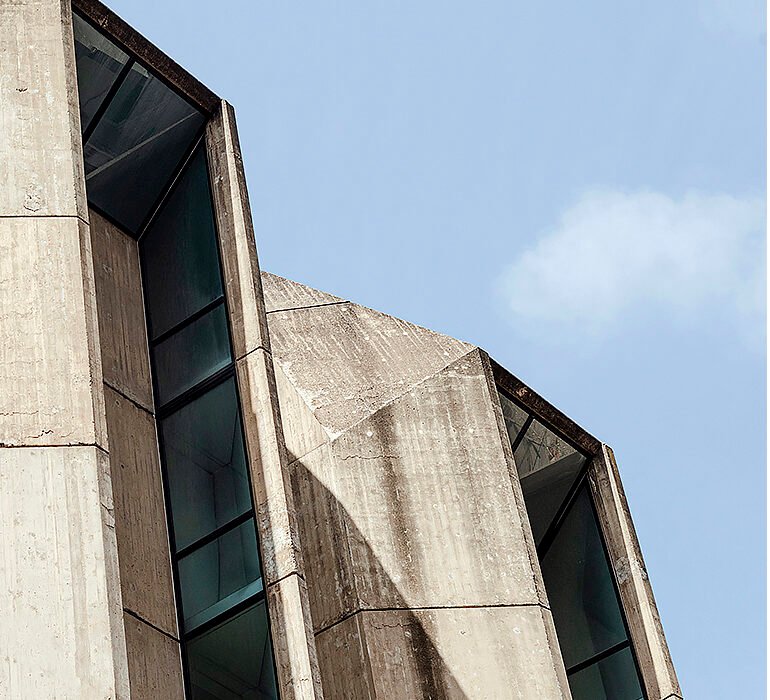
The building embodies core Brutalist qualities: exposed concrete, monumental massing, geometric discipline, repetitive structural rhythm, and an almost defensive inwardness. Its absence of ornament sharpens its impact. Rather than relying on decorative gestures, the structure communicates through form, proportion, and material presence.
Architecture, industry, and design in one project
What makes the Interdesign Building especially fascinating is its origin. Khalil Khoury was not only an architect but also a successful industrialist in furniture production. His company designed, manufactured, and distributed modern furniture in Lebanon, widening access to contemporary design beyond elite circles.
The building was envisioned as the architectural culmination of that ecosystem:
- A production-driven design culture
- A large-scale furniture showroom
- A statement of local innovation and technical capability
- A physical expression of architecture and industry working together
In that sense, the project speaks directly to readers interested in luxury design and collectible modern furnishings. It reflects a moment when architecture, interiors, and manufacturing formed a unified vision of progress.
How war changed the meaning of the building
Construction began in 1974, but the Lebanese Civil War broke out in 1975, stopping the project almost immediately. By the time the building was eventually completed in the late 1990s, the economic and cultural landscape had transformed. Beirut had shifted away from production and toward finance, tourism, and real estate speculation. The original purpose of the Interdesign Building no longer aligned with the city around it.
That history gives the structure its emotional force. It is not simply an abandoned concrete landmark. It is a record of disrupted ambition, changing economies, and the fragility of architectural visions shaped by political upheaval.
Why This Architecture News Resonates With Luxury Design Audiences
The appeal of Brutalist Asia extends beyond scholars and preservationists. For those following luxury architecture and luxury home decor trends, the book offers valuable insight into why Brutalist and late-Modernist spaces continue to influence contemporary taste.
Key reasons include:
- Renewed appreciation for sculptural interiors and bold silhouettes
- Interest in honest materials like concrete, stone, and unfinished wood
- Growing fascination with collectible 20th-century design
- Desire for architecture with narrative depth and historical weight
- A shift toward globally inclusive design references
In today’s market, where refined minimalism often overlaps with material richness, these buildings feel newly relevant. Their dramatic forms and tactile palettes continue to inspire high-end residential design, curated interiors, and editorial conversations around timeless luxury.
A New Chapter in Architecture News
Ultimately, this architecture news story is about more than a publication. It is about rewriting architectural history with greater nuance, geographic breadth, and cultural sensitivity. Brutalist Asia reminds us that Brutalism was never one thing. It was a shared language interpreted differently across nations, climates, and political realities.
Its exploration of Lebanon, and especially the Interdesign Building, offers one of the clearest examples of how architecture can embody both aspiration and rupture. For anyone invested in design culture, modern heritage, or the future of preservation, the takeaway is clear: the most compelling architecture news today often comes from looking beyond familiar narratives and rediscovering the concrete monuments that still shape how we see modernity.