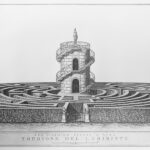
Architecture news often focuses on skylines, materials, and iconic buildings, but some of the most compelling ideas emerge from how we experience space itself. A new architectural discussion centered on the labyrinth invites readers, designers, and homeowners to rethink uncertainty, circulation, and movement as essential ways of understanding architecture.
Rather than treating the labyrinth as a mere historical symbol or decorative motif, this interpretation positions it as a powerful framework for reading buildings, interiors, and landscapes. For audiences interested in luxury architecture, luxury decor, luxury design, and the elevated experience of home, the idea is especially relevant: the most memorable spaces are rarely just seen, they are discovered step by step.
Architecture News and the Return of the Labyrinth in Design Thinking
In recent architecture news, there has been growing interest in how architecture shapes emotion, orientation, and bodily movement. The labyrinth offers a compelling lens because it brings together complexity, sequence, anticipation, and spatial storytelling. Instead of reducing architecture to a fixed object, the labyrinth suggests that buildings are understood through navigation, hesitation, and unfolding experience.
This is particularly meaningful in contemporary design culture, where many architects and interior designers aim to create environments that feel immersive rather than instantly legible. In luxury settings, that can translate into layered entrances, choreographed views, transitional corridors, secluded courtyards, and rooms that reveal themselves gradually instead of all at once.
Why the Labyrinth Still Matters
The labyrinth remains relevant because it captures several core truths about architecture:
- Movement is meaning: circulation patterns influence how a place is perceived.
- Uncertainty creates engagement: partial views and spatial ambiguity can heighten curiosity.
- Sequence shapes memory: people often remember the journey through a space more vividly than its plan.
- Architecture is experiential: design is not only visual, but physical, emotional, and temporal.
These ideas resonate across residential architecture, boutique hospitality, private gardens, and high-end interiors where atmosphere is as important as function.
The Labyrinth as a Reading of Architecture
To read architecture through the labyrinth is to understand space as a process rather than a static composition. This approach emphasizes thresholds, detours, layered access, shifting perspective, and the relationship between concealment and revelation. It asks not only what a building looks like, but how it guides the body and mind.
That perspective aligns well with current conversations in architecture news about sensory design, spatial psychology, and narrative environments. A home, gallery, or retreat can become richer when it does not surrender its logic in a single glance. Instead, it invites occupants to move, pause, and reinterpret.
Key Architectural Elements Linked to the Labyrinth
Designers can translate the labyrinth concept into built form through elements such as:
- Layered entry sequences that create anticipation before the main space opens.
- Controlled sightlines that reveal only fragments of what lies ahead.
- Interconnected rooms that encourage discovery instead of straightforward passage.
- Textural transitions using stone, wood, plaster, or light to mark movement.
- Courtyards and voids that act as moments of orientation within complexity.
In luxury design, these features can elevate a residence from visually impressive to deeply memorable. The goal is not confusion for its own sake, but a carefully orchestrated sense of progression.
What This Means for Luxury Architecture and Luxury Homes
For the world of luxury architecture, the labyrinth offers more than a philosophical metaphor. It provides a practical way to create exclusivity, intimacy, and drama. High-end homes increasingly prioritize experiential value: how arrival feels, how rooms unfold, how privacy is protected, and how exterior and interior spaces connect over time.
In that context, architecture news about the labyrinth speaks directly to luxury living. Grand homes no longer need to rely solely on scale or ornament. Instead, they can express sophistication through spatial rhythm and carefully managed movement.
Luxury Home Applications
Homeowners and designers can apply this approach in subtle yet effective ways:
- Create a transitional entry hall before opening into a dramatic living space.
- Use partitions, screens, or curved walls to soften direct visibility.
- Design garden paths that unfold through planting, water, and stone.
- Connect private suites through layered circulation rather than a single corridor.
- Use lighting to guide movement and shape discovery at different times of day.
These gestures are especially powerful in luxury home decor, where furnishings, finishes, and artwork can reinforce the experience of progression. A sculptural console at a turn, a framed courtyard view, or a shift from polished marble to warm timber all help define a spatial journey.
Luxury Decor, Interior Atmosphere, and the Art of Discovery
In interiors, the labyrinth idea can influence layout, materiality, and mood. Luxury decor is often most successful when it balances openness with intrigue. Fully exposed plans may feel impressive at first, but layered interiors can offer greater comfort, refinement, and emotional depth.
This is where the themes highlighted in architecture news become useful beyond academic discussion. Interior designers can create a sense of mystery without sacrificing elegance or usability. Alcoves, offset doorways, mirrored reflections, and framed transitions between rooms all contribute to an interior narrative.
Design Strategies for Refined Interiors
- Use corridors as curated experiences rather than leftover circulation space.
- Introduce niches for art, objects, or lighting moments that reward movement.
- Balance enclosure and openness to support both privacy and flow.
- Employ tactile materials to make navigation feel sensory, not merely functional.
- Design rooms with layered focal points that emerge gradually.
For luxury home decor, this approach supports a more immersive idea of beauty. The room is not just styled for a photograph; it is composed for lived experience.
Why This Architecture News Story Matters Now
At a time when design is increasingly discussed through wellness, experience, and personalization, the labyrinth offers a timely architectural concept. It reminds us that great spaces do not always reveal themselves immediately. They invite exploration, reward attention, and turn movement into meaning.
That is why this piece of architecture news has significance beyond publishing circles. It points to a broader shift in the design world, where the most compelling architecture is not only monumental or minimal, but emotionally legible through the journey it creates.
For architects, decorators, and luxury homeowners alike, the takeaway is clear: spatial uncertainty, when thoughtfully designed, can become a form of elegance. In the end, the most memorable environments are often those that guide us gently through surprise, rhythm, and discovery. As this architecture news conversation shows, the labyrinth remains one of the most powerful ways to understand architecture today.