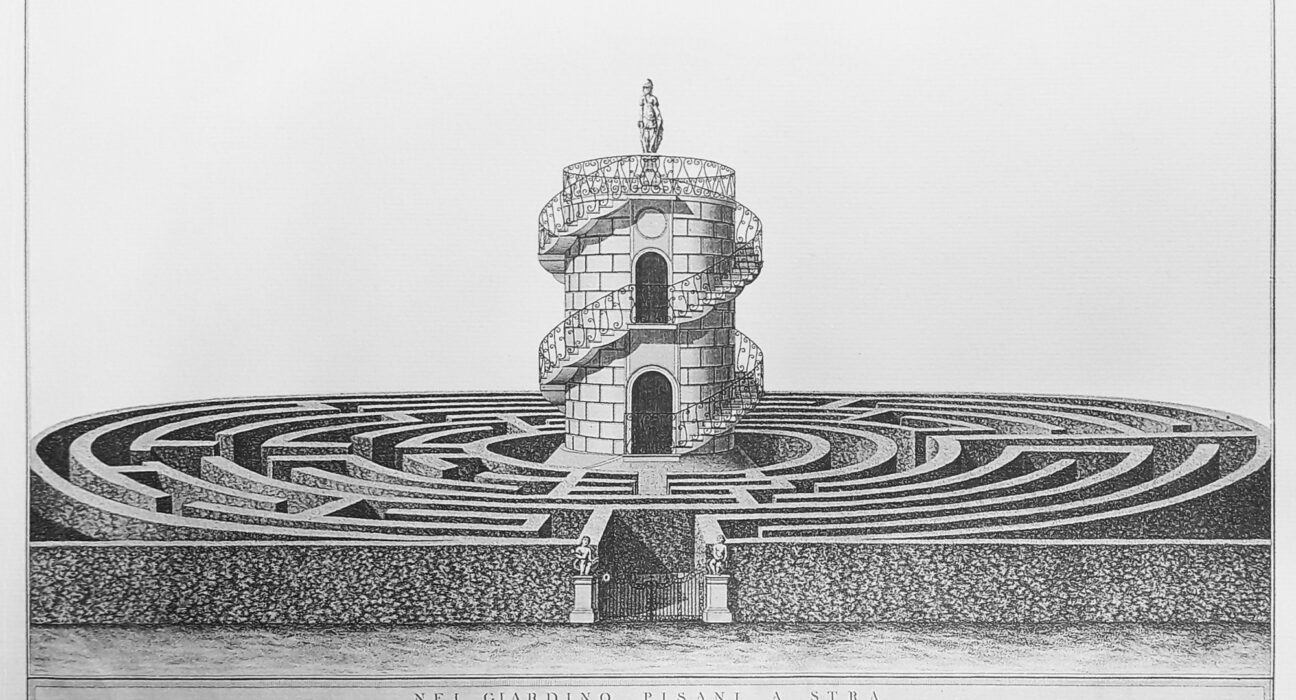
What if the most revealing way to understand architecture is not through order, symmetry, or efficiency—but through uncertainty? In the latest Architecture news, a new publication argues that the labyrinth may be one of the most powerful frameworks for reading space, movement, and the emotional experience of architecture.
O Livro dos Labirintos by Francesco Perrotta-Bosch explores how labyrinthine thinking has shaped architecture across nearly four millennia. Rather than treating the labyrinth as a decorative symbol or mythological curiosity, the book presents it as a spatial principle—one that appears from antiquity to contemporary museums, airports, and retail environments. For readers interested in luxury architecture, luxury design, and elevated spatial storytelling, this is a timely and provocative idea.
Architecture News: Why the Labyrinth Matters Again
This piece of Architecture news stands out because it challenges a long-dominant architectural ideal: that good design must always be instantly legible. Perrotta-Bosch instead asks why architecture’s origins are so often linked to the Labyrinth of Crete, a form associated with detours, ambiguity, and disorientation.
That question opens a broader cultural discussion. If architecture has historically been celebrated for clarity and functionality, the labyrinth proposes another value system:
- Movement over static form
- Discovery over immediate comprehension
- Experience over pure efficiency
- Atmosphere over rigid control
In luxury homes and high-end interiors, these ideas are especially relevant. The most memorable spaces are not always the ones revealed at a glance. Often, they unfold gradually—through sequence, framing, contrast, and carefully controlled circulation.
A Four-Thousand-Year Journey Through Spatial Experience
One reason this Architecture news story resonates is the depth of the research behind the book. Developed over five years within a dual-degree PhD program at FAU USP and Università IUAV di Venezia, the study traces the labyrinth as a recurring architectural logic rather than a singular object.
The book follows this idea across multiple periods, including:
- Greco-Roman antiquity, where the labyrinth emerges through myth and symbolic spatial construction
- Medieval cathedrals, where processional movement and spiritual journey shape perception
- Early modern gardens, where wandering becomes part of designed pleasure
- Contemporary public programs, including museums, airports, and shopping centers
In modern contexts, the labyrinth is often no longer literal. Instead, it becomes a method of organizing circulation and time. Users move through a sequence of choices, pauses, turns, and reveals. Space is not consumed all at once; it is encountered progressively.
How the Labyrinth Connects to Luxury Architecture and Design
For professionals and enthusiasts in luxury architecture, this Architecture news story offers more than literary intrigue. It points to a growing appreciation for experiential design—spaces that are curated as journeys rather than diagrams.
In the luxury sector, that can translate into:
- Grand residential entries that conceal and then reveal dramatic interiors
- Layered floor plans that create intimacy within large homes
- Sculptural corridors and transitions that heighten anticipation
- Landscape design that invites exploration instead of instant overview
- Bespoke home decor arrangements that guide the eye through texture, material, and light
Luxury home design increasingly values emotional pacing. A hallway, stair, courtyard, or gallery wall can function like a miniature labyrinth—not in the sense of confusion, but as a choreographed sequence. The reward is richer spatial memory and deeper engagement.
Against Total Transparency in Contemporary Space
Another compelling takeaway from this Architecture news feature is its critique of modern transparency. Much of 20th-century architecture favored openness, direct orientation, and visual control. The labyrinth resists that mindset.
Instead of presenting everything immediately, labyrinthine architecture accepts:
- Partial views
- Changing perspectives
- Moments of uncertainty
- The possibility of retracing one’s steps
In today’s world of digital mapping, optimized circulation, and hyper-efficient planning, that perspective feels refreshingly human. Not every meaningful environment needs to be frictionless. Sometimes, a slight sense of mystery is what makes a place unforgettable.
This has strong implications for luxury interior design as well. Premium spaces often distinguish themselves through nuance: the turn before a private suite, the hidden garden beyond a stone wall, the gradual reveal of a double-height salon. Controlled disorientation can become a design asset.
An Interdisciplinary Lens on Architecture
This chapter of Architecture news is also notable for the book’s interdisciplinary approach. Perrotta-Bosch links architecture with literature and visual art, drawing on figures such as Jorge Luis Borges and Julio Cortázar, alongside artists and architects including Richard Serra and Álvaro Siza.
That cross-disciplinary framework matters because the labyrinth has never belonged to one field alone. It operates as:
- A mythic structure
- A literary device
- An artistic strategy
- An architectural experience
The book’s own graphic design reportedly mirrors this concept through non-linear reading, making the publication itself part of the argument. In other words, the form of the book reinforces its content: movement is not just a theme, but a method.
Why This Book Matters Now
In current Architecture news, many conversations focus on technology, performance, and optimization. Those concerns are important, but this book reminds us that architecture is also about perception, memory, and the unknown.
That idea feels especially relevant in luxury living, where distinction increasingly comes from atmosphere rather than excess. A refined home is not simply efficient or expensive—it is immersive. It guides residents and guests through a sequence of moods, thresholds, and discoveries.
Perrotta-Bosch’s earlier work on Lina Bo Bardi showed his interest in architecture as a cultural and humanistic practice. With O Livro dos Labirintos, he expands that inquiry by suggesting that architecture is not defined solely by order, but also by its ability to engage what cannot be fully controlled.
Conclusion
This compelling piece of Architecture news reframes the labyrinth as far more than an ancient symbol. It becomes a lens for understanding how architecture unfolds in time, how users build meaning through movement, and why uncertainty can be an essential design tool. For anyone interested in luxury architecture, luxury home decor, or sophisticated spatial design, the takeaway is clear: the most powerful spaces are not always the easiest to read—they are the ones that invite us to keep discovering.