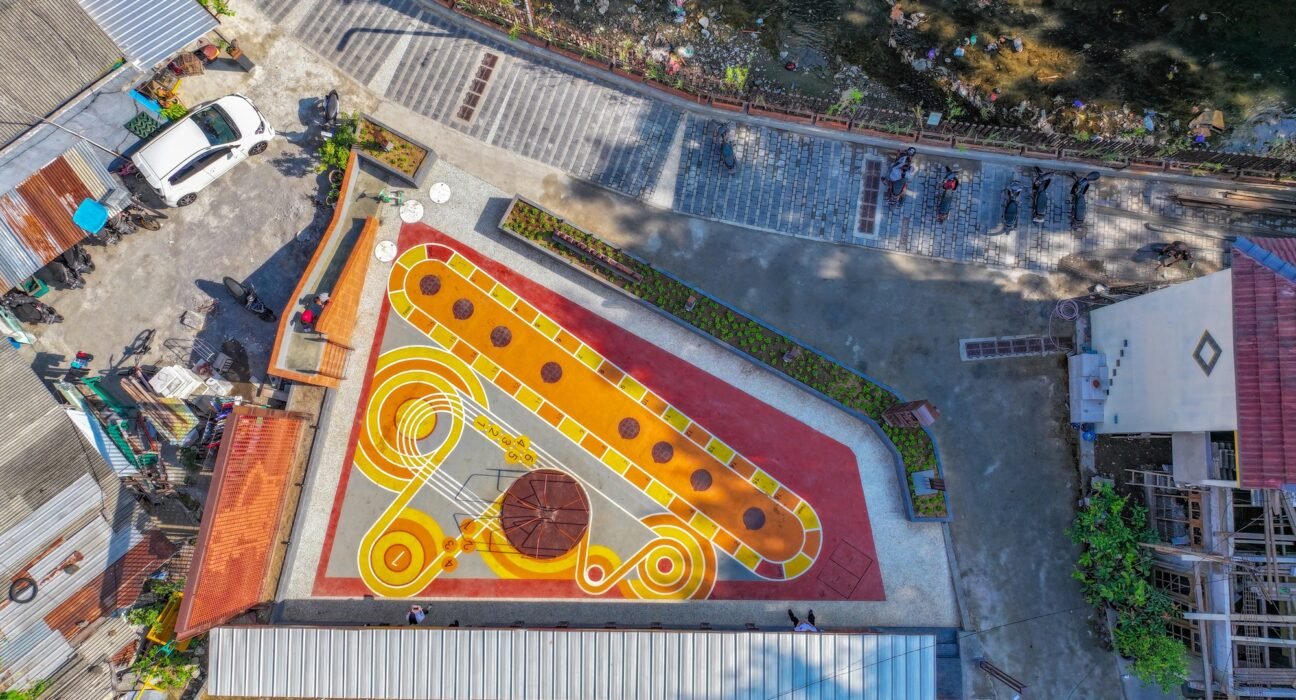
Architecture news rarely feels as intimate and forward-looking as this project in Yogyakarta, where community design, urban repair, and quiet luxury come together in one thoughtful intervention. Kampung Mrican Phase 1 and Microlibrary Pringwulung by SHAU Indonesia show how small-scale, context-driven architecture can elevate everyday life without erasing local identity.
Set in one of Indonesia’s most layered urban environments, the 2024 project spans 4,353 square meters and focuses on a kampung condition that is both highly specific and globally relevant: dense, low-rise neighborhoods under pressure from growth, rental demand, and infrastructure needs. Rather than imposing a sweeping masterplan, SHAU Indonesia approaches the site with precision, creating a model of urban design that feels refined, human-centered, and surprisingly aligned with contemporary ideas of luxury living.
Architecture News from Yogyakarta: A New Vision for the Urban Kampung
For readers following architecture news in Asia, Kampung Mrican offers an important lesson in how design can improve urban life through carefully targeted action. Indonesian kampungs are often defined by tight-knit social structures, narrow pathways, and compact homes. In Yogyakarta, Kampung Mrican sits near two major universities, which adds another layer to its identity: it serves both long-term residents and a transient rental population.
This dual character creates architectural challenges and opportunities. The neighborhood must support density and economic activity while preserving its social fabric. SHAU Indonesia’s response avoids the pitfalls of top-down redevelopment. Instead, the project embraces what the architects describe as an acupunctural approach—strategic interventions that strengthen the whole environment while respecting what already exists.
That strategy is especially relevant in today’s architecture news landscape, where the most admired projects are often those that balance sustainability, heritage, and quality of life.
What Makes This Project Stand Out
At first glance, Kampung Mrican Phase 1 and Microlibrary Pringwulung may not fit a conventional luxury architecture narrative defined by grand gestures or expensive finishes. Yet this is precisely where the project becomes compelling for luxury-focused audiences. It reframes luxury as spatial intelligence, community value, and a strong sense of place.
A context-sensitive design approach
Rather than replacing the kampung fabric, the design works with it. This means:
- Preserving the neighborhood’s existing identity
- Improving daily functionality through strategic public interventions
- Supporting community use with cultural and educational programming
- Enhancing urban dignity without displacing residents
In premium design discourse, this kind of restraint is increasingly seen as sophisticated. True luxury design is no longer only about exclusivity; it is also about meaning, longevity, and craftsmanship in planning.
The microlibrary as a civic luxury
The inclusion of Microlibrary Pringwulung adds a powerful public dimension. Libraries at a small scale can become anchors for community life, especially in dense urban areas where shared spaces are limited. Here, the microlibrary is more than a functional amenity—it represents access, learning, and collective aspiration.
For those interested in luxury home decor and luxury design trends, there is a valuable takeaway: spaces feel elevated when they are purposeful. A well-designed reading room, shaded communal area, or beautifully resolved circulation path can create a richer experience than purely decorative excess.
Why It Matters for Luxury Architecture and Design
This story deserves attention beyond local architecture news because it points to where high-end design thinking is heading. Across luxury architecture, there is growing admiration for projects that deliver emotional quality and social intelligence alongside visual clarity.
Kampung Mrican reflects several themes that resonate strongly with luxury sectors:
- Authenticity: The project does not imitate global trends at the expense of local identity.
- Human-scale planning: It prioritizes lived experience over monumental form.
- Lasting value: Community-focused design can age better than short-lived spectacle.
- Cultural depth: The work is rooted in Indonesian urbanism while speaking to international audiences.
For homeowners, designers, and developers, the message is clear: refined environments are not defined solely by price point. They are defined by care, proportion, material sensitivity, and how well they serve the people who use them.
SHAU Indonesia’s Design Leadership
Led by Florian Heinzelmann and Daliana Suryawinata, SHAU Indonesia has built a reputation for socially aware, visually intelligent work. In this project, supported by a multidisciplinary team, consultants, and public-sector collaboration, the studio demonstrates how urban design can be both pragmatic and aspirational.
The delivery of a project like this depends on coordination across architecture, civil works, environmental planning, and construction. That collaborative depth matters. It ensures that a neighborhood intervention is not just conceptually strong, but also buildable, resilient, and relevant to everyday use.
Within current architecture news, that kind of interdisciplinary rigor is increasingly essential. The best projects are not simply photogenic—they solve real urban problems with elegance.
Lessons for Luxury Homes, Interiors, and Community-Centered Design
Although Kampung Mrican is a public-facing urban project, its ideas translate surprisingly well to the world of luxury home and luxury home decor. Designers can draw inspiration from its principles in several ways:
- Create layered spaces that support both privacy and community
- Use architecture to strengthen routines, not just aesthetics
- Preserve original character when renovating older properties
- Invest in small but meaningful interventions with lasting impact
- Prioritize local materials and climate-responsive design
These lessons reflect a broader shift in high-end interiors and residential design. Today’s most compelling luxury homes are often those that feel grounded, tactile, and connected to their surroundings rather than detached from them.
Conclusion: Architecture News That Redefines Luxury
In a year crowded with headline-grabbing projects, this piece of architecture news stands out for its humility, intelligence, and relevance. Kampung Mrican Phase 1 and Microlibrary Pringwulung prove that architectural excellence can emerge from careful listening, strategic design, and respect for community fabric.
For anyone interested in luxury architecture, luxury decor, or the future of urban living, the takeaway is simple: the most powerful design is not always the loudest. Sometimes, the finest expression of luxury is a place made more livable, more beautiful, and more meaningful for everyone it serves.