Architecture news this week reveals a powerful shift in how cities are being designed, reused, and future-proofed. From global housing resilience efforts to a refined timber-hybrid government building in Berlin, the latest developments show that luxury architecture today is increasingly defined not just by aesthetics, but by adaptability, sustainability, and civic value.
Across housing policy, cultural infrastructure, and educational design, the week’s standout stories point to a broader evolution in the built environment. For readers interested in luxury architecture, luxury home trends, and elevated design thinking, these projects offer a compelling look at how high-level ideas are reshaping urban life.
Architecture News Highlights a Global Push for Better Housing
One of the most urgent themes in current architecture news is housing access. UN-Habitat has named five recipients of its 2026 Scroll of Honour Award, recognizing work that advances adequate housing and sustainable urban development in Brazil, Myanmar, Pakistan, Tunisia, and the United Kingdom.
The announcement arrives at a critical moment. According to UN-Habitat’s World Cities Report 2026, as many as 3.4 billion people worldwide still lack adequate housing. That statistic underscores a core reality for architects, planners, and developers: residential design is no longer only about delivering new buildings, but about creating homes that are safe, resilient, and dignified.
For the luxury sector, this matters too. Premium residential design increasingly draws influence from broader urban priorities, including:
- climate-responsive planning
- durable, locally sourced materials
- healthy indoor environments
- long-term flexibility and reuse
- community-centered design strategies
In other words, the values shaping humanitarian and public-interest design are also informing the next generation of luxury homes and luxury home decor.
Adaptive Reuse Is Becoming Central to Luxury Design Thinking
Another defining thread in this week’s architecture news is adaptive reuse. In Houston, construction has started on the Frank Liu Jr. Academy for Music and Arts, a new tuition-free public charter school designed by OMA under Jason Long, with RDLR Architects and SWA Group. The project transforms a 1930s industrial coffee plant into a vibrant educational campus.
The design preserves the original façade while introducing contemporary learning spaces, skylit communal zones, and a double-height cafetorium. It is a strong example of how existing structures can be reimagined for modern social use without erasing their architectural memory.
This approach has become especially relevant in luxury architecture and luxury design, where clients increasingly value character, provenance, and sustainability. Adaptive reuse can deliver all three. Rather than starting from scratch, designers are finding ways to turn warehouses, factories, and legacy office buildings into richly layered destinations with distinct identity.
Why reuse resonates in high-end architecture
- Historic fabric adds uniqueness and authenticity
- Embodied carbon is preserved, supporting sustainability goals
- Older structures often offer generous volumes and durable materials
- Converted buildings can create one-of-a-kind luxury living experiences
As a result, adaptive reuse is no longer a niche strategy. It is a major force in both civic architecture and premium real estate.
Cultural Projects Are Redefining the City Experience
This week’s architecture news also highlights the role of culture in city-making. In Los Angeles, Frank Gehry’s expansion of the Colburn School is set to open in 2027, anchored by the new Terri and Jerry Kohl Hall, a 1,000-seat concert venue designed with audiences surrounding performers in an intimate in-the-round arrangement.
The project combines striking formal expression with functional sophistication. Interlocking volumes, metallic finishes, garden connections, and adjustable acoustic elements create a building that is both iconic and highly responsive to performance needs.
At the same time, Turin’s Utopian Hours 2026 festival is bringing architects, urban strategists, and researchers together to discuss public space, climate adaptation, food systems, and participatory urbanism. While very different in format, both developments reflect a growing idea in architecture news: cities thrive when cultural space is treated as essential infrastructure.
For luxury design audiences, these projects are important because they influence expectations beyond public buildings. Homeowners, developers, and interior designers are increasingly seeking residences that echo the same qualities found in world-class cultural architecture:
- immersive spatial experience
- strong indoor-outdoor relationships
- refined material palettes
- spaces designed for gathering, performance, and wellness
Berlin’s Timber-Hybrid Government Building Sets a New Standard
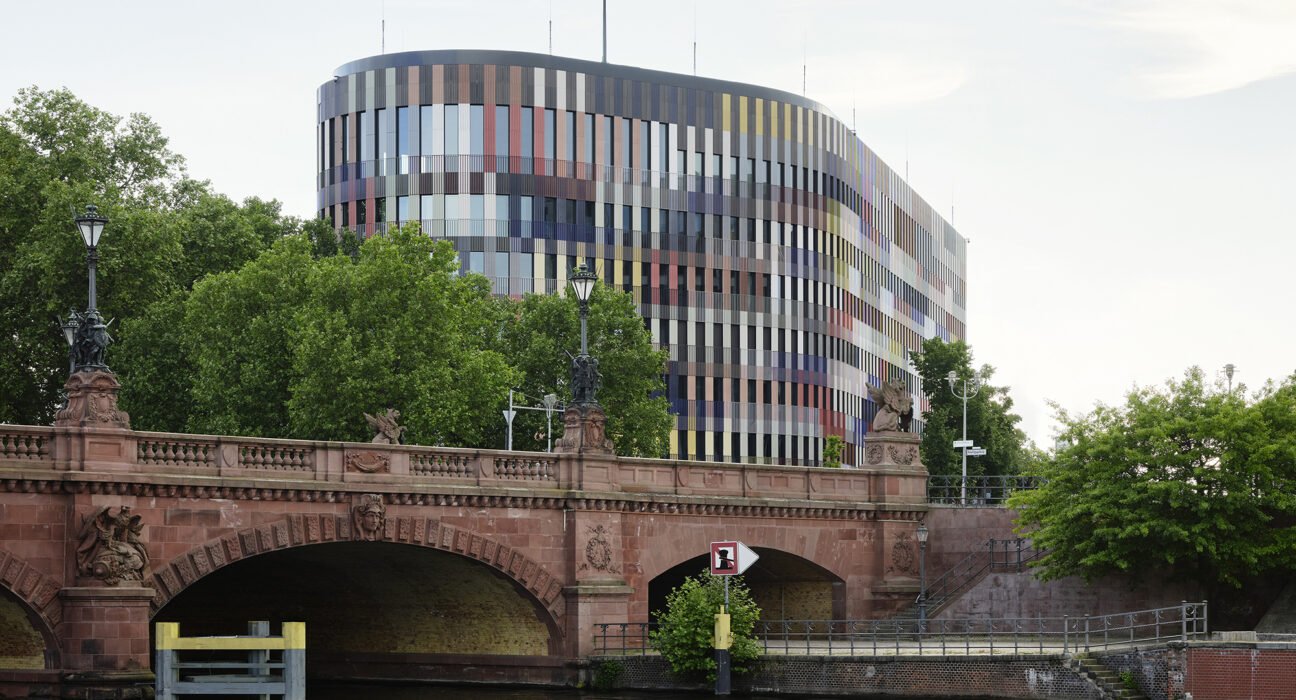
The most visually and technically notable item in this week’s architecture news may be sauerbruch hutton’s completed Office Building for Federal Authorities at the Spreebogen in Berlin. Built as the temporary seat of Germany’s Federal President during the refurbishment of Schloss Bellevue, the 18,700-square-meter complex demonstrates how public architecture can be elegant, efficient, and adaptable at once.
The project consists of two timber-hybrid buildings that combine prefabricated timber office modules with reinforced concrete cores and plinths. Its façade, layered with colored railings and fluted glazed ceramic elements, creates a dynamic appearance that shifts across the elevations.
What makes the Berlin project stand out
- Timber-hybrid construction: a lower-carbon alternative that supports faster, more efficient assembly.
- Design sophistication: the façade balances civic dignity with a vibrant contemporary identity.
- Circular thinking: the building was planned for future reuse by another federal authority.
- Adaptability: its long-term utility extends well beyond its temporary political role.
For luxury architecture professionals, this project is especially meaningful. It shows that prestige no longer depends on excess. Instead, distinction comes from intelligent systems, material innovation, and long-term value.
Education and Mixed-Use Revivals Expand the Conversation
Elsewhere in architecture news, Benthem Crouwel Architects and Nieuwe Architecten have finalized the redesign of the Interfaculty Learning Centre at the University of Groningen. The scheme retains much of an existing 1960s structure while integrating timber and biobased materials, improved solar shading, and more flexible learning environments.
In Perth, Henning Larsen has proposed Mill Green, a mixed-use redevelopment that transforms three office buildings into a connected precinct with new public space, landscape, retail, and hospitality. By focusing on ground-level experience, climate response, and phased renewal, the project reflects a wider movement toward softer, more livable urban regeneration.
Together, these stories reinforce a key takeaway from this week’s architecture news: the most forward-looking projects are not simply new, they are strategic. They conserve resources, enhance public life, and create enduring design value.
Conclusion: What This Architecture News Means for Luxury Living
The clearest lesson from this week’s architecture news is that the future of great design lies in resilience, reuse, and adaptability. Whether through UN-Habitat’s housing advocacy, Gehry’s cultural expansion in Los Angeles, or sauerbruch hutton’s timber-hybrid Berlin complex, today’s most influential architecture is balancing beauty with long-term purpose.
For anyone tracking luxury architecture, luxury decor, luxury home innovation, and elevated urban design, these projects signal where the market is headed next: toward spaces that are sustainable, emotionally resonant, and built to evolve. In the best architecture news, style and substance are no longer competing ideals—they are the new standard.