

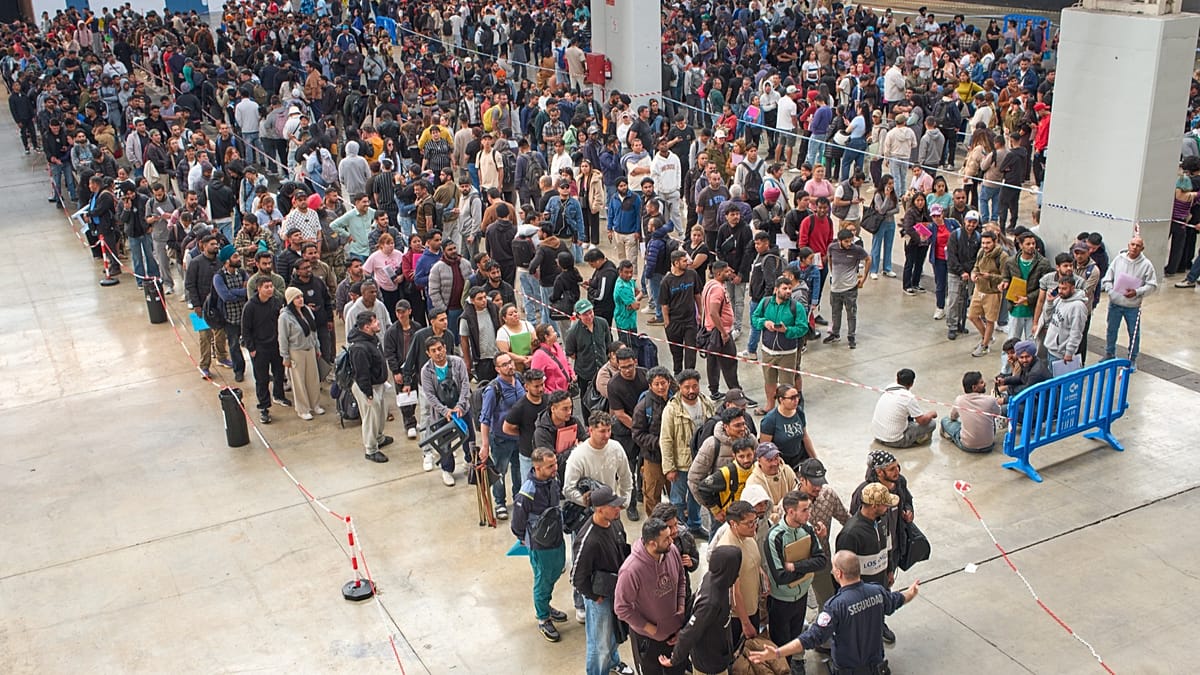
Spain’s migrant regularisation scheme is being discussed as an immigration policy, but its ripple effects extend far beyond politics. For the worlds of luxury architecture, luxury design, and luxury interiors, the programme could become a quiet but powerful force behind labour supply, project delivery, and the future of high-end construction in Spain.
According to official figures, nearly 1.2 million undocumented migrants applied for legal status under Spain’s new scheme between mid-April and the end of June 2026. While not all applications will be approved, the scale of demand highlights a major shift in how Spain may support sectors that rely on skilled and semi-skilled labour, especially construction, fit-out, renovation, and specialist trades tied to premium residential and hospitality projects.
Why Spain’s migrant regularisation scheme matters to luxury architecture
Prime Minister Pedro Sánchez has openly linked the initiative to workforce needs, including construction. That matters because luxury architecture depends on more than visionary concepts and prestige materials. It also relies on the people who pour concrete, install stone, fabricate joinery, manage site logistics, and deliver the precise craftsmanship expected in elite properties.
Spain has become one of Europe’s most watched markets for upscale villas, branded residences, boutique hotels, and design-led urban redevelopment. In that context, Spain’s migrant regularisation scheme may help address one of the industry’s biggest constraints: access to labour.
For developers, architects, and interior studios, labour shortages can lead to:
- Longer construction timelines
- Higher build and refurbishment costs
- Delays in bespoke interior installation
- Reduced flexibility for complex custom projects
- Pressure on specialist craftsmanship capacity
If more workers gain legal status and work permits, even within a limited framework, Spain’s building ecosystem could become more stable. That would be particularly relevant in regions where luxury real estate demand remains strong, from Madrid and Barcelona to Marbella, Ibiza, and parts of the Balearics.
The labour link between migration and luxury design
Luxury design is often associated with aesthetics, exclusivity, and innovation, yet behind every refined space is a highly coordinated labour chain. Spain’s migrant regularisation scheme brings attention to the workers who make high-end environments physically possible.
Construction and fit-out need reliable staffing
High-value homes and hospitality interiors require a broad mix of trades, including plasterers, tilers, electricians, carpenters, metalworkers, stone installers, painters, and furniture fabricators. A shortage in any one area can stall an entire project. Legal regularisation may reduce workforce instability and make hiring more transparent for contractors and suppliers operating in premium segments.
Craftsmanship is central to luxury interiors
Luxury interiors in Spain increasingly blend local materials, artisanal finishes, and custom detailing. From natural stone bathrooms to handcrafted millwork and tailored lighting plans, premium projects demand accuracy and continuity on site. A more secure workforce can support quality control, scheduling, and specialist execution.
Hospitality expansion raises demand
Spain’s luxury hospitality market continues to evolve, with resorts, private members’ clubs, and design hotels pushing for elevated guest experiences. These projects often require fast but meticulous build programmes. Spain’s migrant regularisation scheme could support the staffing needs that make those rollouts more achievable.
What the official figures reveal
The final application count reached 1,174,978, with more than 600,000 already being processed by the time the figures were announced. The applicant base was notably young, with 80% under the age of 45, suggesting a potentially active workforce for sectors facing labour pressure.
The nationality breakdown also offers useful context for the broader labour market:
- 67% of applications came from Latin America
- 22.9% came from African nationalities
- Colombia accounted for 25.9% of total applications
- Morocco represented 13.3%
- Venezuela accounted for 11.8%
- Peru represented 8.8%
Not every applicant will be approved, and earlier expectations suggested around 500,000 people may ultimately regularise their status. Applicants must prove a clean criminal record and show they were in Spain for at least five consecutive months before 1 January. Authorities then have three months to assess whether to grant a work and residence permit valid only in Spain.
Even with those limits, Spain’s migrant regularisation scheme stands out in a Europe-wide climate where many governments are tightening irregular immigration rules.
Potential impact on Spain’s high-end property pipeline
The connection between immigration policy and high-end property may seem indirect, but luxury development is extremely sensitive to execution risk. A shortage of legal workers can affect everything from shell construction to final styling. If Spain’s migrant regularisation scheme improves labour availability, several outcomes are possible.
- Greater project predictability: Developers may face fewer staffing disruptions.
- Improved compliance: Contractors can rely more on formal employment structures.
- Better delivery standards: Stable teams can help maintain consistency across design and build stages.
- More confidence in expansion: Investors may view Spain as better equipped to support complex real estate programmes.
This is especially relevant for luxury architecture, where bespoke forms, precision engineering, and premium materials leave little room for labour gaps or rushed substitutions.
Political controversy, economic reality
Spain’s migrant regularisation scheme has drawn strong criticism from conservative and far-right opponents, who argue it could encourage more irregular immigration. At the same time, business leaders have welcomed the move, reflecting the economic reality that many sectors need workers.
For the luxury design and interiors industries, the debate is not simply ideological. It is operational. Can Spain continue delivering exceptional homes, hotels, and lifestyle spaces if labour shortages intensify? The answer may depend partly on whether this regularisation effort succeeds in turning an informal workforce into a legal, more dependable one.
That does not mean every challenge disappears. Training, wage pressure, housing affordability for workers, and regional disparities in project demand will still shape the market. But formalising labour can be a foundational step toward a healthier construction environment.
Conclusion: a policy with design-world consequences
Spain’s migrant regularisation scheme is first and foremost a social and economic policy, but its implications for luxury architecture, luxury design, and luxury interiors should not be overlooked. Nearly 1.2 million applications reveal the scale of untapped labour capacity already present in the country, much of it potentially relevant to construction and fit-out.
If approvals translate into a more stable workforce, Spain’s migrant regularisation scheme could help support premium real estate delivery, artisanal craftsmanship, and high-end hospitality development in one of Europe’s most dynamic design markets. For architects, developers, and interior professionals, the key takeaway is clear: migration policy may increasingly shape the future of luxury space-making in Spain.