
The first David Hockney auction since the artist’s death was always going to draw intense scrutiny from collectors, curators, and luxury design observers alike. Yet the result delivered a more nuanced story than many expected: strong demand, deep interest, and no dramatic posthumous price spike.
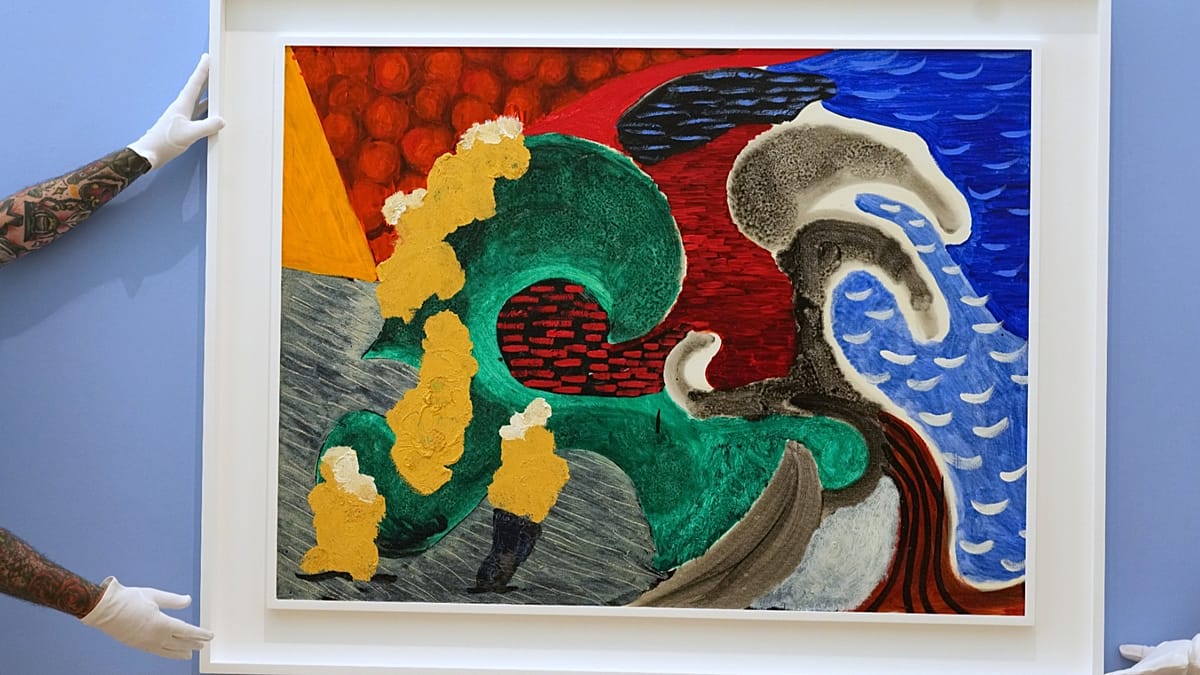
At Phillips’ Modern & Contemporary Art sale in London on 26 June, Hockney’s 1991 painting The Only One with Waves sold for £2.42 million, just under its upper estimate of £2.5 million. For the luxury art market, the sale matters far beyond a single lot. It offers a revealing snapshot of how blue-chip works are being valued when legacy, scarcity, and emotion collide.
What the first David Hockney auction reveals
The latest David Hockney auction centered on a painting that marks an important creative shift in the artist’s career. Created after Hockney bought his home in Malibu, The Only One with Waves captures the energy of the Pacific Ocean rather than the calm geometry of the swimming pools that helped define his global reputation.
That distinction is important for collectors. This is not simply another Hockney canvas; it is a transitional work that reflects his movement away from the polished stillness of Los Angeles scenes and toward a more fluid, expressive handling of nature and abstraction.
The sale’s final figure suggests the market recognized the painting’s significance, but remained disciplined. Instead of a bidding frenzy driven purely by recent headlines, the David Hockney auction result aligned closely with established valuations.
Why the price did not show a posthumous premium
When a major artist dies, the market often braces for a “posthumous premium” — a sudden surge in prices fueled by urgency, media attention, and fears of reduced future supply. In this case, that premium did not meaningfully appear.
Even though interest in Hockney’s work reportedly surged after his death, the auction result stayed within expectations. That tells us several things about the upper end of the luxury collectibles market:
- Collectors are pricing with discipline, not emotion alone.
- Hockney’s market was already mature before his death, leaving less room for speculative leaps.
- Top-tier buyers value provenance and period as much as news cycle momentum.
- Institutional confidence remains strong, which tends to stabilize prices rather than distort them.
In other words, the David Hockney auction demonstrated resilience instead of volatility. For luxury investors and design-led collectors, that stability can be just as attractive as a record-breaking headline.
The importance of “The Only One with Waves” in Hockney’s oeuvre
For anyone tracking museum-quality art and luxury decor trends, this painting’s importance lies in its place within Hockney’s broader visual language. Measuring 91.4 x 122 cm, the oil on canvas channels the wild movement of the Pacific, offering a more atmospheric and restless mood than his iconic pool paintings.
It also reflects a wider shift in how Hockney engaged with place. Malibu introduced a different natural force into his work: less architecture, more motion; less surface glamour, more elemental rhythm. That evolution makes the painting particularly compelling for serious buyers looking beyond the most recognizable Hockney motifs.
Why transitional works matter to collectors
Transitional works often hold a special place in the luxury art market because they reveal an artist in motion. Rather than repeating a proven formula, they capture experimentation, risk, and development.
For collectors, that can translate into value through:
- Greater art historical importance
- Broader institutional appeal
- Stronger curatorial storytelling
- Rarity within a famous body of work
That context helps explain why the David Hockney auction attracted such close attention, even without a sensational final price.
What this means for luxury brands, decor, and design audiences
The sale also resonates beyond the auction room. In luxury decor and interior design, Hockney remains a touchstone for color confidence, Californian modernism, and a refined yet playful approach to visual space. His works continue to influence everything from collectible furniture curation to contemporary residential styling.
For luxury brands, the measured outcome of this David Hockney auction reinforces a broader message: enduring cultural value often outperforms short-term hype. That principle applies not only to fine art, but also to watches, furniture, fashion, and limited-edition design objects.
Hockney’s world — saturated light, bold composition, and emotional clarity — remains deeply relevant to premium lifestyle aesthetics. As collectors build homes around art, not just with art, works connected to his legacy will likely continue informing luxury interiors and high-end design sensibilities.
David Hockney’s legacy is still expanding
Although the David Hockney auction marked the first major public sale after his death, it is only one part of a much larger legacy story. Hockney’s influence remains active in schools, galleries, foundations, and upcoming institutional exhibitions.
His roots in Bradford continue to be celebrated locally, while major public collections preserve his work for international audiences. Looking ahead, planned exhibitions at Tate Britain and a multimedia presentation of his opera set designs at Tate Modern will keep attention fixed on his creative range.
There is also an important long-term market factor at play: the artist’s privately held works are expected to move largely into foundations and public institutions. That could tighten supply in the private market over time, especially for significant paintings with clear provenance.
A legacy built on more than market performance
Hockney’s staying power comes from more than auction records. His appeal spans multiple worlds at once:
- Fine art and museum culture
- Luxury interiors and design inspiration
- British cultural heritage
- Global contemporary collecting
That breadth helps explain why every major David Hockney auction is likely to remain a closely watched event.
Final takeaway from the David Hockney auction
The first major David Hockney auction since the artist’s death did not produce a speculative surge — and that may be the most meaningful result of all. Instead, it showed a sophisticated market honoring quality, context, and legacy without abandoning pricing discipline.
For collectors in luxury art, decor, and design, the message is clear: Hockney’s cultural and aesthetic relevance remains immense, but the smartest buyers are still guided by connoisseurship over hype. In a world where scarcity often drives emotion, this David Hockney auction proved that true blue-chip status is built on lasting significance.