
Architecture news rarely captures a shift in how cities might care for people as clearly as this one. In Brescia, Italy, seven architecture and design practices have been selected to transform the Spedali Civili hospital campus into a future-facing medical district where landscape, research, and healing are treated as one interconnected system.
The winning team includes CRA-Carlo Ratti Associati, Park Associati, Politecnica Building for Humans, Openfabric, DOTDOTDOT, Studio Mattioli, and Eckersley O’Callaghan. Their proposal rethinks an important historic healthcare complex while preserving the site’s original radial logic, first conceived in the early 20th century by engineer Angelo Bordoni. The result is a sophisticated masterplan that blends high-performance medical architecture with public space, environmental design, and long-term flexibility.
Architecture News: A New Vision for Brescia’s Spedali Civili
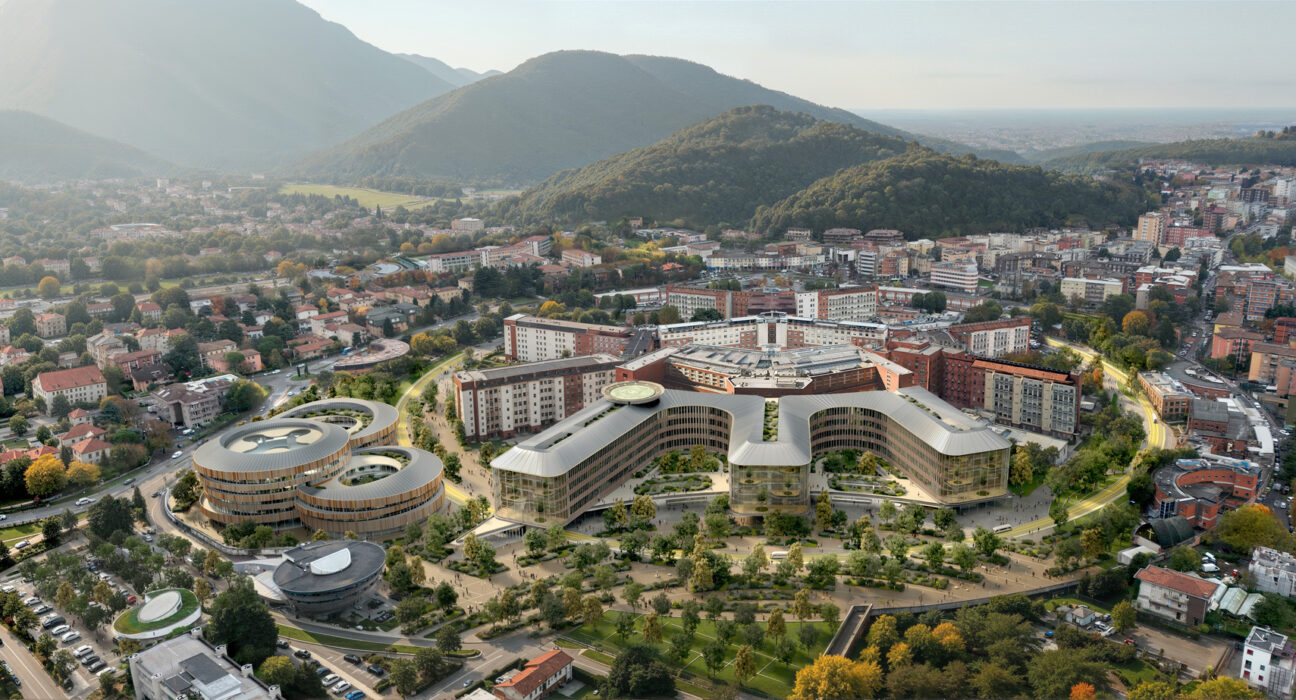
This major redevelopment centers on a new Main Hospital and a new Children’s Hospital, both designed to extend and reinterpret the campus’s hexagonal and radial plan. Rather than erase history, the proposal builds on it, creating a contemporary framework for care rooted in urban continuity and spatial clarity.
At the heart of the scheme is the CareRing, a circular infrastructure stretching more than one kilometer around the existing campus. This bold intervention serves multiple purposes at once:
- It connects the hospital more directly to the city
- It separates logistics and technical services below ground
- It creates therapeutic landscapes and public green space at street level
- It supports biodiversity and microclimate improvement
- It reinforces a patient-centered model of movement and wellbeing
For readers following architecture news, this project stands out because it applies the increasingly influential One Health principle: the idea that human health, environmental health, and social wellbeing are inseparable. That concept is not just theoretical here; it shapes the site plan, circulation, landscape, and building systems.
A Hospital Campus Designed as Public Infrastructure
One of the most compelling aspects of the Brescia proposal is its treatment of the hospital as civic architecture. Instead of functioning like an inward-looking institutional complex, the redeveloped campus is envisioned as an integrated public infrastructure that welcomes daily urban life.
Ground-level landscapes designed by Openfabric will link squares, gardens, and green corridors, allowing patients, staff, and visitors to move through outdoor spaces as naturally as they move through corridors and wards. This approach aligns with broader trends in luxury architecture and luxury design, where wellness, biophilic planning, and experience-driven environments are increasingly central.
The project also gives new life to the historic pavilions. As clinical and technological functions shift into the new facilities, older structures are expected to be adapted for:
- Academic programs
- Medical research
- Innovation hubs
- Community-facing activities
That strategy should strengthen ties with the University of Brescia’s Faculty of Medicine, turning the campus into a richer ecosystem where care, education, and discovery happen side by side.
The Main Hospital: Healing Architecture at Urban Scale
The new Main Hospital is organized into three interconnected wings that follow the original radial geometry of the campus. A continuous glazed lobby at ground level faces a new public square, creating a welcoming threshold between hospital and city.
This is where the project’s healing architecture ambitions become especially clear. The interior planning prioritizes qualities proven to improve comfort and orientation, including:
- Abundant natural daylight
- Acoustic comfort
- Balanced proportions
- Framed views toward the Brescia Prealps
- Shorter, more efficient circulation routes
At the ends of the wings, glazed winter gardens reduce the sense of confinement often associated with large medical buildings. These landscaped spaces help maintain a visual and emotional connection to nature, reinforcing the idea that recovery is shaped not only by technology but also by atmosphere.
In the context of architecture news, this project reflects a larger movement toward healthcare spaces that are both technically advanced and deeply humane.
The Children’s Hospital Brings Warmth, Flexibility, and Comfort
The Children’s Hospital takes a different formal approach, using three cylindrical volumes of varying heights connected by terraces and internal courtyards. The geometry softens the institutional feel and creates a more welcoming environment for younger patients and families.
Its entrance is centered on a full-height atrium designed as a social heart, with play areas and consultation zones integrated into a protected interior landscape. This is an important detail: pediatric care environments work best when they reduce stress, support family presence, and create moments of normalcy.
Design features expected to define the Children’s Hospital include:
- Terraced outdoor spaces
- Internal courtyards for light and orientation
- A social atrium with play and waiting zones
- Flexible planning for evolving healthcare models
This kind of emotionally intelligent planning is why the story deserves attention in architecture news circles beyond Italy.
Sustainable Construction and Future-Ready Design
Both hospitals will use a hybrid timber-and-steel structural system assembled through dry construction techniques. This modular approach supports faster building timelines, lowers embodied carbon, and allows future reconfiguration as medical technologies change.
The development will also incorporate intelligent systems for:
- Wayfinding
- Flow management
- Environmental monitoring
- Operational efficiency
These features matter because hospitals must now do more than meet immediate clinical needs. They must also adapt over decades. The Brescia masterplan addresses that challenge through flexible infrastructure rather than fixed, obsolete typologies.
Construction is expected to begin in 2028, making this one of the most important long-range healthcare projects currently featured in architecture news.
Why This Italian Project Matters Globally
The Brescia redevelopment joins a growing list of international projects redefining medical architecture through landscape and wellbeing. Comparable examples include Renzo Piano Building Workshop’s hospital-landscape concept in France, Kéré Architecture’s community-based healthcare design in Burundi, and the adaptive renewal of Aalto’s Paimio Sanatorium by Snøhetta.
What sets Brescia apart is the way it merges historical continuity, urban openness, and environmental intelligence into one coherent vision. It speaks to several design worlds at once: luxury home sensibilities around wellness and light, luxury decor thinking about atmosphere and material comfort, and luxury architecture values that prioritize refinement, performance, and longevity.
For anyone tracking architecture news, the takeaway is clear: the hospital of the future is no longer an isolated machine for treatment. It is a connected civic landscape that brings together care, education, research, and nature in a more graceful and resilient whole.
As this ambitious Italian project moves toward construction, it offers one of the clearest signals yet in architecture news that healthcare design is entering a new era—one where beauty, flexibility, and public life are no longer optional, but essential.