Architecture news rarely stays relevant for nearly a century, yet the Barcelona Pavilion continues to shape the way designers, homeowners, and architects think about luxury modernism. First unveiled for the 1929 International Exposition in Barcelona, this iconic work by Ludwig Mies van der Rohe with Lilly Reich remains a masterclass in restraint, material richness, and spatial elegance.
Originally known as the German Pavilion, the project represented a new image of Germany after World War I: progressive, refined, and culturally confident. Today, it stands not just as a landmark of modern architecture, but as a lasting reference point for luxury architecture, luxury decor, and high-end residential design. In a world where visual excess often competes for attention, the Barcelona Pavilion proves that simplicity, when executed brilliantly, can feel more opulent than ornament.
Architecture News: The Enduring Influence of the Barcelona Pavilion
In the history of architecture news, few buildings have had the staying power of the Barcelona Pavilion. Completed in 1929 in Spain, the pavilion was designed as an exhibition space rather than a conventional building. Yet its impact far exceeded its temporary purpose. It became one of the clearest statements of the modern movement and a defining work in Mies van der Rohe’s career.
What made the pavilion revolutionary was not size or decorative flourish, but composition. It rejected traditional enclosure and instead explored open-plan living, fluid transitions, and the emotional power of premium materials. These ideas now feel familiar in luxury homes and luxury interiors, but at the time they were radically new.
The pavilion also reflected collaboration at the highest level. While Mies van der Rohe is the name most often associated with the project, Lilly Reich played a vital role in shaping its spatial and material sophistication. Their partnership helped produce an environment that felt both serene and ceremonial.
The Design Language That Changed Modern Architecture
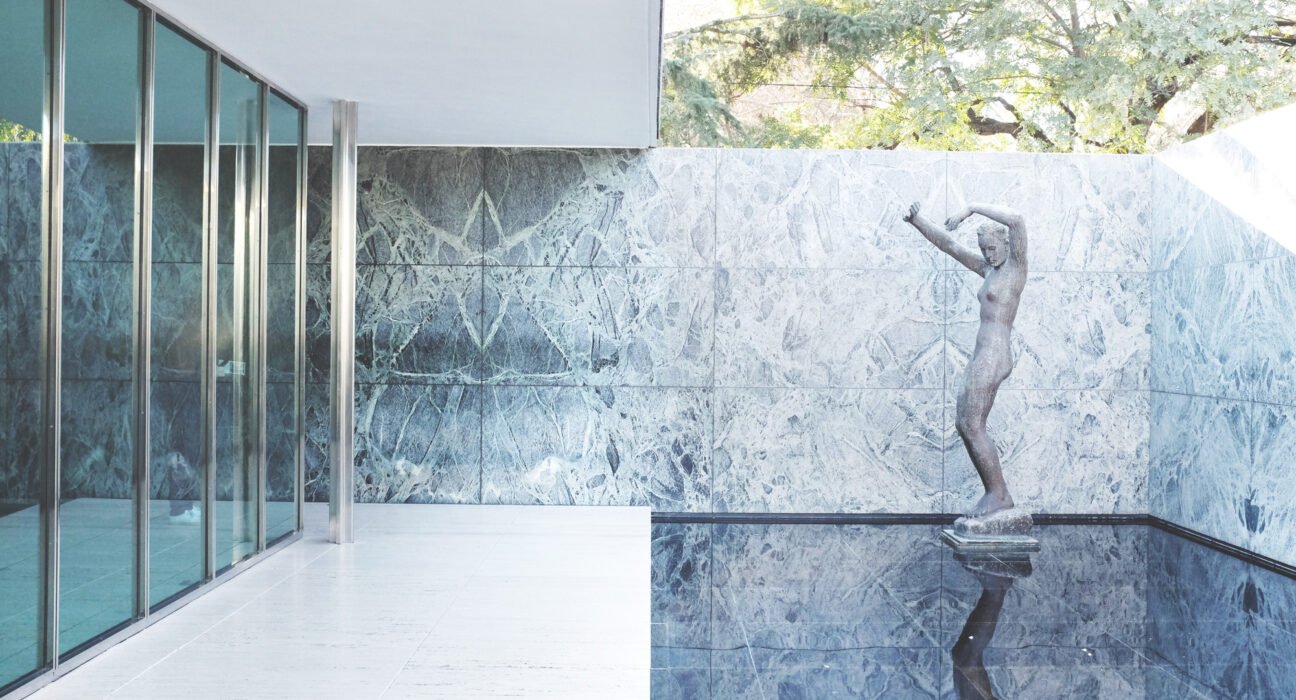
The Barcelona Pavilion is often praised for its minimal form, but its true brilliance lies in the balance between austerity and indulgence. The structure is composed of horizontal planes, slender supports, and carefully placed walls that guide movement without fully confining it. This created a new architectural language centered on freedom, continuity, and visual calm.
Open space as luxury
One of the pavilion’s greatest legacies is its treatment of space. Rather than dividing rooms with heavy barriers, the design uses planes and reflections to suggest zones. In contemporary luxury home design, this concept appears in expansive living areas, seamless indoor-outdoor transitions, and layouts that prioritize experience over compartmentalization.
Materiality over ornament
The pavilion demonstrates that luxury does not require excess decoration. Instead, it relies on the beauty of carefully selected natural materials. Stone, glass, and polished surfaces do the visual work, creating depth and softness through texture, light, and reflection. This philosophy remains central in luxury decor and luxury home decor, where the quality of finishes often matters more than quantity.
Precision in every detail
Another reason the project remains central to architecture news is its obsessive refinement. Every joint, proportion, and surface relationship contributes to the whole. This level of control is a hallmark of timeless luxury design, where the smallest details often define the overall atmosphere.
Why the Barcelona Pavilion Still Matters in Luxury Architecture
For those following architecture news through the lens of luxury architecture, the Barcelona Pavilion offers lessons that remain remarkably current. It shows how a home or space can feel exclusive without being overdesigned. It also highlights how emotional impact often comes from restraint, not spectacle.
Its influence can be seen in many contemporary design priorities:
- Minimalist forms paired with premium natural materials
- Open plans that encourage flow and flexibility
- Floor-to-ceiling glazing and visual continuity
- Curated furnishings instead of crowded interiors
- Quiet, contemplative spaces that feel both intimate and grand
These principles are now standard in many high-end residences, boutique hospitality projects, and collectible design spaces. The pavilion’s legacy extends well beyond public architecture into the heart of luxury living.
Lessons for Luxury Home and Decor Enthusiasts
The relevance of the Barcelona Pavilion is not limited to architects. It also offers inspiration for homeowners, interior stylists, and anyone interested in elevated spaces. Following architecture news often means identifying ideas that can translate into everyday environments, and this project offers several.
1. Invest in fewer, better materials
Rather than layering many finishes, choose a restrained palette with exceptional quality. Natural stone, warm wood, bronze tones, and reflective glass can create a rich atmosphere without visual clutter.
2. Let space breathe
Luxury home interiors often feel more sophisticated when they are edited. Leave room between furnishings, prioritize circulation, and allow signature pieces to stand out.
3. Use light as a design element
The pavilion teaches that light is not just functional; it is part of the composition. Reflections, transparency, and shadow all contribute to a space’s mood. In luxury home decor, this can be achieved through glazing, polished surfaces, and thoughtful lighting placement.
4. Embrace timeless modern furniture
The pavilion is closely linked to iconic modern furnishings, reinforcing the idea that furniture should complement architecture rather than compete with it. Sculptural seating, clean lines, and restrained silhouettes continue to define upscale interiors.
A Landmark That Continues to Shape Architecture News
There is a reason the Barcelona Pavilion still appears in architecture news, design education, and luxury design conversations around the world. It represents a rare convergence of ideology, craft, and beauty. More than a historic pavilion, it is a blueprint for modern elegance.
Its influence endures because it answers a question that still matters: what makes a space feel truly luxurious? The pavilion’s response is clear—clarity, proportion, material excellence, and calm. For architects and design lovers alike, that message remains as powerful now as it was in 1929.
In the world of architecture news, trends come and go, but the Barcelona Pavilion endures as a benchmark for refined living. Its lasting takeaway is simple: true luxury is not about adding more, but about choosing better.