

7 Famous Movie Sets and Filming Locations You Can Still Visit Today
Hannah · November 29, 2026
Luxury editor · Salvina O’Hara
A movie set can disappear as soon as the cameras stop rolling—or become a place travelers can explore for years afterward. From a permanent fantasy village in New Zealand to a former prison in Philadelphia, these seven locations offer a real-world connection to stories once seen on screen.
They are not all preserved in the same way: some are polished visitor attractions, while others are weathered sites whose histories extend well beyond their film appearances. For anyone planning ireland travel or a wider international itinerary, these destinations show how cinematic landmarks can add a distinctive stop to a trip around the world.
Movie locations transformed into visitor attractions
Hobbiton, New Zealand
Near Matamata, a family-owned sheep farm provided the rolling hills and lake that filmmakers used as the setting for the Shire in The Lord of the Rings. The original Hobbit Holes were largely temporary, but some façades remained after filming. When production returned for The Hobbit trilogy, the village was rebuilt with more durable materials.
Today, Hobbiton has 44 Hobbit Holes, along with gardens, fences, winding paths and the Green Dragon Inn. The surrounding land remains a working farm, while the film set operates as a major tourist attraction with guided visits. It is a rare case where a temporary production environment became a carefully maintained destination in its own right.
Luke Skywalker’s home, Tunisia
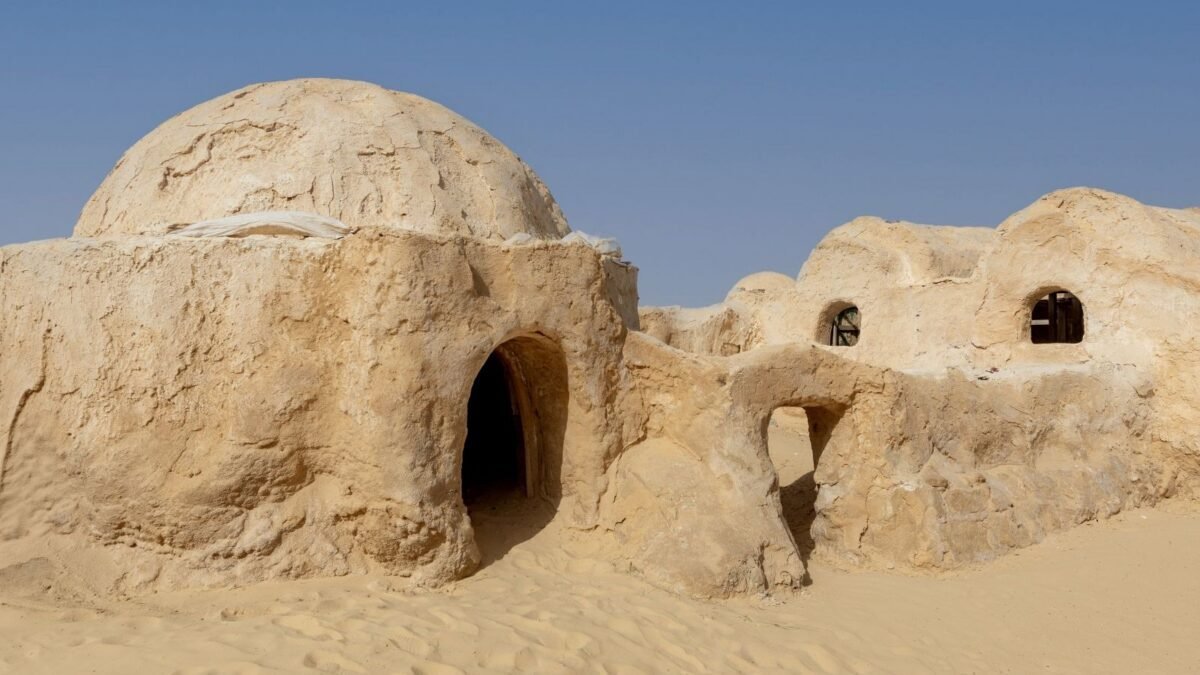
The Lars homestead in Star Wars is associated with two locations in Tunisia. The exterior dome and courtyard were built on the Chott el-Djerid salt flats, while the underground interiors were filmed at Hotel Sidi Driss in Matmata. The hotel remains open and retains decorations linked to the films.
The desert exterior has faced damage from weather and shifting sand, and it was reconstructed for Attack of the Clones. Restoration efforts have helped keep the site from disappearing. Visitors interested in the setting should know that the familiar homestead is not one intact building: its film identity is shared between a working hotel and a remote desert location.
Popeye Village, Malta
Built on the shoreline of Anchor Bay for the 1980 film Popeye, Sweethaven was designed as a seaside town with crooked wooden buildings and bright, exaggerated details. Rather than dismantle the set after production, Malta kept it as a visitor attraction.
Now known as Popeye Village Malta, it offers access to the surviving buildings, museums and exhibits, live entertainment, mini-golf and boat rides around the bay. The coastal setting brings maintenance challenges, including storms and salt spray, but the village remains a family-friendly stop with a distinctly cinematic look.
Film history in landscapes shaped by time
Spectre, Alabama
Tim Burton’s Big Fish brought the fictional town of Spectre to Jackson Lake Island near Montgomery. The set was left behind after filming, and weather, vegetation and storms have since altered it. Some structures have disappeared or deteriorated, but the entrance sign and several buildings remain recognizable.
The privately owned island operates as a recreational destination, with day visits, fishing, kayaking and camping. Visitors can see what remains of the town, though it is better understood as a changing, weathered film site than a fully preserved set.
Henry River Mill Village, North Carolina
For The Hunger Games, filmmakers used the existing Henry River Mill Village as the basis for District 12 rather than building an entire town. Established as a company community for textile workers in the early twentieth century, the village had become largely empty before filming. Its aged buildings and roads suited the story’s setting.
The 72-acre site has since drawn visitors interested in both the movie and the village’s industrial past. Guided tours provide a way to explore those overlapping histories. The location’s significance is not solely cinematic: it also preserves a record of a real community shaped by the textile industry.
Sad Hill Cemetery, Spain
The striking circular cemetery used for the final standoff in The Good, the Bad and the Ugly was constructed in Spain’s Mirandilla Valley for the 1966 film. About 250 Spanish soldiers helped build more than 5,000 artificial graves around a central cobblestone plaza.
After production, the site was overtaken by vegetation. Restoration began in 2015, when volunteers from the Sad Hill Cultural Association cleared the area and rebuilt the grave layout. The association maintains the site and marks its movie history, making this a compelling example of fans helping bring an abandoned location back into view.
Eastern State Penitentiary, Philadelphia
Opened in 1829 and closed in 1971, Eastern State Penitentiary supplied the real cellblocks and corridors used in 12 Monkeys. Its imposing architecture and years of deterioration gave the film an unsettling setting without requiring a complete studio recreation.
The former prison is now a historic site and museum, with audio tours, guided programs, exhibits and art installations. Visitors can explore many of the cellblocks while learning about the building’s history as well as its role in cinema. Unlike an abandoned set, it is an established heritage attraction with organized visitor experiences.
How to choose a movie-location visit
These places offer very different kinds of trips, so check current access arrangements before setting out. A practical shortlist can help:
- For a fully developed attraction: consider Hobbiton or Popeye Village.
- For a blend of cinema and heritage: look at Henry River Mill Village or Eastern State Penitentiary.
- For a more weathered, landscape-led visit: explore the information available for Spectre or Sad Hill.
- For a film-linked overnight stay: Hotel Sidi Driss remains a working hotel associated with the Star Wars interior scenes.
Take the story beyond the screen
Visiting a famous movie location is not always like stepping into a perfectly preserved set. Some sites are carefully managed attractions; others are fragments reshaped by weather, time and local preservation work. That contrast is part of their appeal. Check access details in advance, respect site rules and remember that places such as Henry River Mill Village and Eastern State Penitentiary have histories that began long before the cameras arrived.