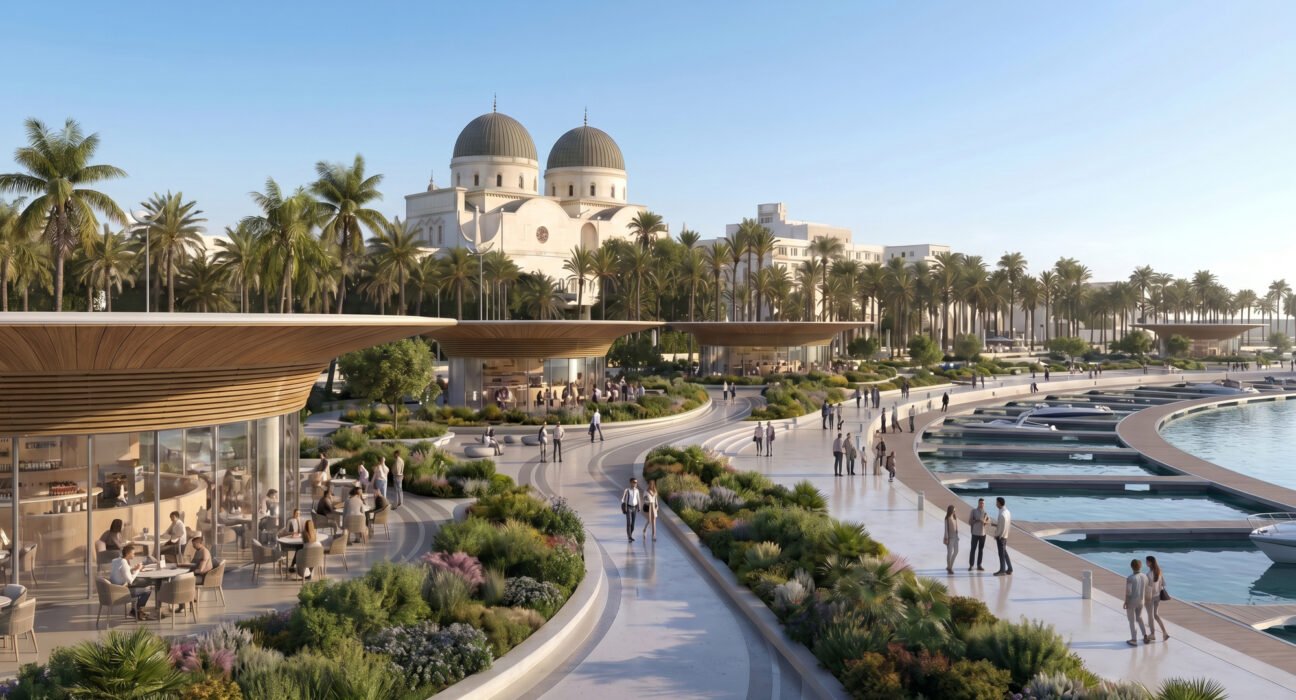
Architecture news rarely captures the scale of a city’s future as vividly as Benghazi’s newly revealed 2050 vision. Led by Zaha Hadid Architects and its collaborators, the proposal introduces not just a master plan, but a digital planning hub designed to help Benghazi rebuild, grow, and modernize with long-term precision.
For readers interested in luxury architecture, luxury design, and the evolution of ambitious urban environments, this project stands out as more than a planning exercise. It represents a bold attempt to combine design excellence, data-driven governance, and resilient infrastructure into one integrated framework for Libya’s second-largest city.
Architecture News Spotlight: What the Benghazi 2050 Plan Proposes
At its core, the Benghazi 2050 initiative is a future-facing urban strategy intended to guide the city’s development over the coming decades. Rather than relying on piecemeal construction, the plan points toward a coordinated approach that can shape mobility, housing, public space, infrastructure, and economic growth together.
The involvement of Zaha Hadid Architects gives the vision global architectural significance. The studio is known for fluid forms, complex urban thinking, and projects that merge landmark aesthetics with advanced planning logic. In Benghazi, that design intelligence appears to be paired with a practical ambition: creating a framework that can help local stakeholders make informed decisions over time.
Key themes behind the plan include:
- Long-term urban regeneration for a city with major strategic and cultural importance
- Digital planning tools that support smarter decision-making
- Integrated infrastructure to connect districts and improve daily life
- Resilience and adaptability in the face of future environmental and social pressures
- Economic development potential through coordinated growth and investment
This kind of architecture news matters because it shows how architecture is increasingly tied to systems thinking. Today, great design is no longer only about individual buildings; it is also about how cities function, evolve, and respond to change.
The Role of the Digital Planning Hub
One of the most compelling aspects of the proposal is the digital planning hub. While master plans often look impressive on paper, implementation is usually the hardest part. A digital platform can help bridge that gap by turning the city vision into a living, measurable process.
In practical terms, a digital planning hub may allow planners, officials, and stakeholders to visualize scenarios, assess infrastructure needs, coordinate land use, and evaluate the impact of future development. This creates a more dynamic model of urban governance, where decisions can be revised as conditions change.
Why digital urban planning matters
Digital planning tools are becoming central to contemporary urban design because they improve both clarity and coordination. For a city planning toward 2050, this approach offers several advantages:
- Better forecasting: Data modeling helps estimate population growth, transport demand, and infrastructure stress.
- Faster coordination: Multiple agencies can work from a shared planning framework.
- Greater transparency: Visual systems make complex planning decisions easier to understand.
- Improved resilience: Cities can test strategies before committing to expensive physical interventions.
As architecture news increasingly intersects with technology, projects like Benghazi’s show how digital tools can become as important as physical design in shaping urban futures.
What This Means for Luxury Architecture and Design Audiences
Although the Benghazi 2050 plan is urban in scale, it has clear relevance for luxury architecture and luxury home audiences. Large master plans often influence the design language, material culture, and development standards of future residential and hospitality projects. When a city invests in a strong planning identity, high-end architecture often follows.
For the luxury sector, several signals stand out:
- Elevated design benchmarks: Global design leadership can inspire more refined future developments.
- Premium waterfront and urban districts: Strategic planning often unlocks desirable new residential areas.
- Lifestyle-led public realm: Well-designed boulevards, green spaces, and cultural zones increase long-term value.
- Smart city integration: High-end buyers increasingly expect seamless technology, mobility, and sustainability.
This makes the story relevant beyond public policy. It is also a lens into how future luxury living may emerge in cities undergoing transformation. For followers of architecture news, Benghazi offers a case study in how civic ambition can reshape the design market from the ground up.
Benghazi’s Strategic Importance in Libya’s Urban Future
Benghazi has long held an important position in Libya’s economic, cultural, and geographic landscape. Any comprehensive city plan for Benghazi therefore carries national significance. A 2050 strategy is not simply about expansion; it is about defining identity, improving quality of life, and establishing the conditions for sustained renewal.
Urban plans of this scale typically address interconnected priorities such as:
Infrastructure and mobility
Efficient transport networks, road hierarchies, and public connectivity are essential to reducing congestion and improving access across districts.
Public realm and livability
Parks, plazas, walkable streets, and civic amenities shape how residents experience the city every day.
Economic competitiveness
Clear planning frameworks can attract investment by offering certainty, structure, and a more compelling development vision.
Environmental performance
Forward-looking planning increasingly considers climate responsiveness, resource management, and long-term resilience.
That broader urban context is why this piece of architecture news feels especially important. It is not about a single signature building. It is about the operating system of a future city.
Why the Project Stands Out in Global Architecture News
Major city plans are unveiled regularly, but relatively few combine internationally recognized design leadership with digital governance tools and long-range urban strategy in such a direct way. The Benghazi 2050 vision signals a shift from static master planning toward a more agile and data-informed model.
For global observers, the project stands out because it reflects several larger trends in architecture and urbanism:
- The rise of digitally managed cities
- The growing overlap between architecture, planning, and technology
- The demand for resilient urban frameworks in rapidly changing regions
- The importance of design in post-conflict or renewal-focused contexts
In that sense, this architecture news story is both local and international. It speaks to Benghazi’s future, but also to the wider direction of 21st-century city making.
Conclusion
The ZHA-led vision for Benghazi’s 2050 city plan is a powerful example of how architecture news can reveal much more than aesthetic ambition. It highlights a model of urban development where design, technology, and long-term planning work together to shape a more resilient and sophisticated city.
For anyone tracking luxury architecture, urban innovation, or the future of design-led development in North Africa, Benghazi is now a city to watch. If this vision is carried through with consistency and local impact, it could become one of the region’s most important examples of strategic urban transformation.